News · Mikołaj Skubina · 20.05.2026
Purchasing a drive is only the beginning of the expenses. In practice, TCO (Total Cost of Ownership) covers not only the price of the geared motor, motor or frequency inverter, but also energy, commissioning, service, spare parts, training, administration and, above all, the costs of failures and downtime. In drive systems, 80–85% of TCO arises after the purchase, in "downstream" processes such as energy consumption, maintenance, parts storage and downtime.
For production plants this means one thing: the cheapest drive on the invoice is very often not the cheapest over its entire period of operation. That is why drive cost analysis should cover the device's full life cycle, not just the CAPEX (Capital Expenditures) at the purchase stage. This approach also fits well with the role of SPEC SERWIS, which supports customers with advice on selecting NORD solutions and with technical and operational analysis, not only with sales itself.
What TCO means in drive systems
TCO, i.e. Total Cost of Ownership, is a method of calculating the total cost of ownership of a given solution over its entire life cycle. We define TCO as an analysis of all costs incurred from purchase and commissioning, through operation and maintenance, to recycling or disposal.
In practice, for NORD drives and other industrial drive systems, TCO usually includes:
- purchase of the device and accessories,
- installation, commissioning and parameterisation,
- electrical energy,
- planned inspections and routine replacements,
- spare parts and service logistics,
- administrative and warehousing costs,
- the cost of failure and the cost of production downtime,
- the end-of-life cost of the product.
This is exactly why TCO analysis is far more useful than simply comparing two offer prices. It allows hidden costs to be seen, risks to be caught earlier and the real savings potential to be located. NORD states directly that TCO helps identify hidden costs, assess savings potential and make better investment decisions.
In the case of the NORD brand this is particularly significant, because we are talking about solutions used in many demanding industries, from intralogistics and internal transport to the food industry, mixing, cranes and bulk materials. There, even a small improvement in efficiency or a shortening of downtime can translate into very large sums of money.
What costs does a drive generate during operation
The largest cost component in many applications is not the purchase itself, but operation. NORD states that electric drives account for as much as up to 70% of total energy consumption in industry, which is why every improvement in efficiency can have a real impact on a plant's cost balance.
The most important operating costs are energy, service, parts, the working time of the maintenance department and the consequences of unplanned stoppages. In drives working in multiple shifts, energy can be the dominant cost item. This applies especially to applications with a high number of operating hours per year, frequent partial-load operation, and changing speed and load.
That is exactly why efficiency at the real operating point matters, not just in the catalogue. IE5+ motors maintain high efficiency also at partial load and lower speeds, which gives them an advantage over classic asynchronous motors in many intralogistics and transport applications.
The example from NORD materials is very concrete. A comparison of an IE3 0.75 kW motor with a corresponding IE5+ 0.75 kW motor shows around 11% energy savings at 16 operating hours per day and 4000 hours per year. NORD also indicates that its IE5+ motors achieve motor efficiency of up to 95% in the 0.35–4.0 kW range.
In addition to energy come the costs of servicing. Inspections, oil changes, temperature checks, reading frequency inverter parameters or clearing faults are all elements of the real TCO. SPEC SERWIS experience shows that in practice a plant must take into account not only the component itself, but also service availability, diagnostics and parts, as well as the response time to a failure.
How production downtime affects costs
This is where it is easiest to understate the calculation. The cost of production downtime is often greater than the annual price difference between a cheaper drive and a better-quality one.
The Siemens report "The True Cost of Downtime 2024" shows the scale of the problem for large plants. According to this study, the average large plant in the surveyed sectors now loses around USD 253 million a year due to unplanned downtime, and the world's 500 largest industrial companies together almost USD 1.4 trillion a year, which corresponds to around 11% of their revenues. In the automotive industry, an hour of downtime at a large plant has been estimated at as much as USD 2.3 million.
Of course, this does not mean that every factory has identical rates. But the conclusion is simple: the more critical the application, the greater the role of reliability, parts availability and speed of service response. For conveyors, sorting centres, agitators, packaging lines or continuous transport systems, even a short stoppage can trigger a domino effect across the whole process.
The cost of downtime must include more than lost production. It also includes the cost of people's labour, urgent parts deliveries, service overtime, the risk of quality rejects, delivery delays and the time to restart the line. Siemens also draws attention to the costs of emergency spare parts and potential contractual penalties.
That is why drive cost analysis should always include a separate item: the risk and cost of an unplanned stoppage. This is very often the element that completely changes the outcome of the calculation.
Why cheap drives are often more expensive
A cheaper drive can be tempting at the purchase stage, but after commissioning the economics of the life cycle take over. When a device has lower efficiency, tolerates overloads worse, requires a greater number of warehouse variants or more frequent service intervention, the initial saving quickly disappears. The purchase itself is usually only around 15% of a drive's life-cycle cost, and the rest is later costs.
Standardisation also matters a great deal. NORD emphasises that two of the main factors lowering TCO are energy consumption and the number of drive variants used in the plant. The more versions, the larger the parts warehouse, more documentation, greater service complexity and a higher risk of errors during servicing.
This is exactly why standardised and modular solutions so often win over the long horizon. LogiDrive and similar configurations help limit the number of variants, reduce maintenance costs and simplify service. In DuoDrive solutions the manufacturer additionally points to a smaller number of wear-prone elements, which translates into less downtime and lower maintenance costs.
It is also worth noting a simple organisational aspect. A cheap drive bought without an analysis of application requirements can mean later problems with selecting the gear ratio, installation position, cooling, control or oil selection. And then the cost grows through corrections, rework and service, even though at the beginning everything looked "cheap".
How to calculate the total cost of a drive
The simplest TCO model can be written as follows:
TCO = purchase + installation and commissioning + energy + planned service + spare parts + cost of failures and downtime + decommissioning cost
This is of course a simplified model, but in practice a very useful one. To calculate it sensibly, it is worth going through a few steps.
First you need to establish the baseline data: motor power, number of operating hours per year, load profile, speed, ambient temperature, control mode and application criticality. Without this, every calculation will be just guesswork. NORD emphasises that the optimum drive system must be selected for the specific application requirements and operating conditions.
Next, calculate the energy cost. In practice it is enough to estimate the annual kWh consumption for the variants under consideration and multiply it by the energy rate. In applications with a high number of operating hours, even a few percentage points of efficiency difference make a big difference over the course of a year.
The next step is service and parts. You need to include oil changes, checks, bearings, seals, maintenance man-hours, logistics and possibly a warehouse of critical parts. Here, standardisation and the availability of original parts become particularly important.
Then calculate the cost of stoppage risk. It is worth applying a simple formula:
downtime cost = number of stoppage hours per year × cost of 1 hour of downtime
The cost of one hour can be calculated as the sum of lost margin, labour costs, idle energy, any penalties, quality losses and the costs of restarting the process. In many plants this is precisely the largest item.
Finally, compare 2–3 drive variants over a period of 5, 7 or 10 years. Only then will you see whether the apparently cheaper option really makes sense.
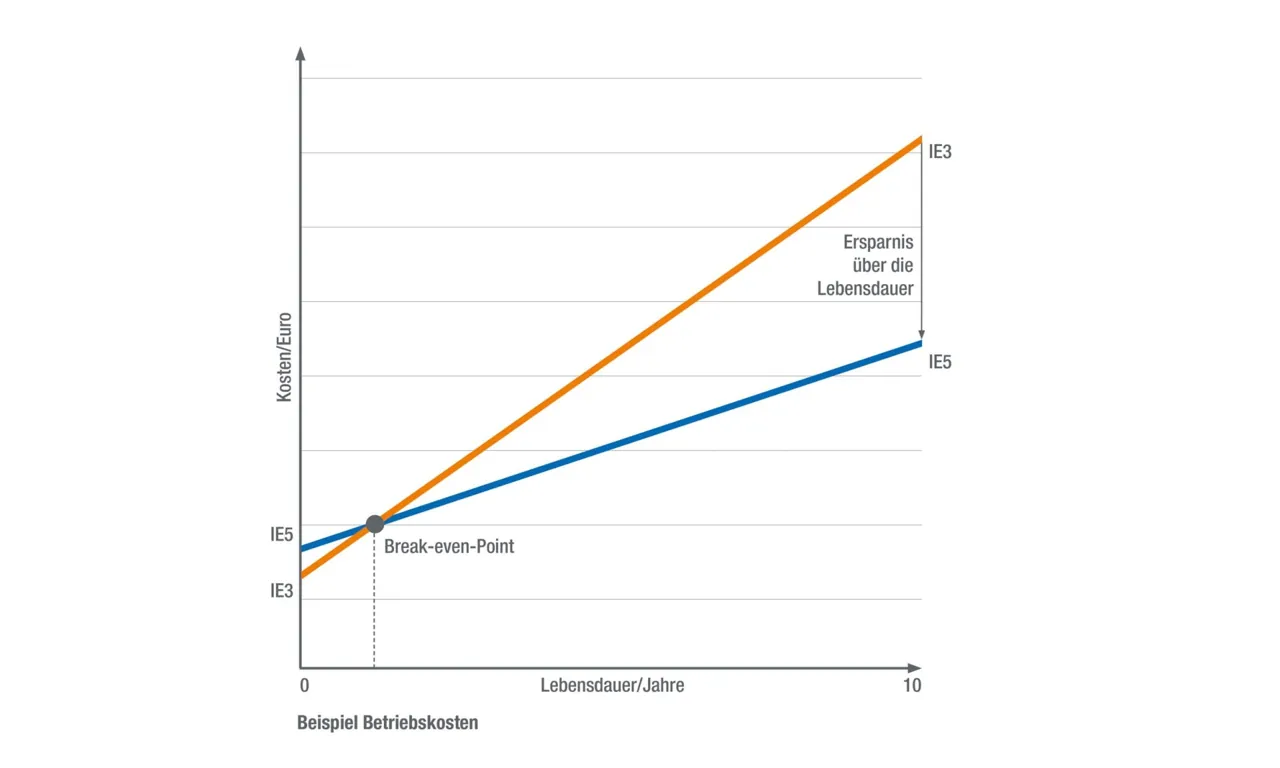
How to reduce costs over the device life cycle
The greatest savings potential usually lies in three areas: efficiency, reliability and standardisation.
First, it is worth selecting the drive for the real operating point, not "with reserve" without analysis. NORD indicates that the following matter a great deal: the lowest possible energy consumption, constant efficiency over a wide range of speed and torque, high overload capacity, low service effort and a long service life.
Second, it pays to limit the number of variants in the plant. Fewer drive types mean a simpler warehouse, easier documentation, fewer errors and a shorter response time in the event of failure. This is one of the key conclusions from NORD materials on TCO and LogiDrive.
Third, you need to work with operational data. NORD emphasises the benefits of the predictive maintenance approach: earlier detection of impermissible operating states, plannable stoppages, reduced service and material costs, and increased system availability.
In practice this means:
- monitoring temperature, vibration and load,
- planning inspections based on condition, not just the calendar,
- maintaining a list of critical parts,
- analysing energy consumption after commissioning,
- periodically reviewing the correctness of frequency inverter parameters and operating conditions.
At this point the role of SPEC SERWIS is very concrete. We support customers in selecting NORD drives, with inspections, fault diagnosis, assessment of geared motor condition, routine replacements and work with frequency inverters. It is precisely such activities that help limit TCO not only at the purchase stage, but throughout the entire period of use.
FAQs
Below you will find short answers to the questions that most often arise when analysing drive costs.
Is drive TCO only the cost of purchase and energy?
No. TCO also includes installation, commissioning, service, spare parts, administration, downtime and, at the end, the decommissioning of the device. That is exactly why the purchase price is only a fragment of the total cost.
When does TCO analysis make the most sense?
Above all, when the drive operates many hours per year, is a critical element for production continuity or appears in many repeated stations. The more operating hours and the greater the cost of a stoppage, the greater the value of such an analysis.
Will a more expensive NORD drive always be more cost-effective?
Not always. Cost-effectiveness depends on the application, load profile, number of operating hours, environmental conditions and the cost of a potential stoppage. In many applications a technically better drive gives a lower life-cycle cost, but this must be calculated for the specific case.
How do you calculate the cost of production downtime?
The simplest way is to multiply the number of stoppage hours by the cost of one hour. This cost should include lost production, people's labour, quality losses, restart costs and any penalties or urgent parts deliveries.
Does motor efficiency really affect TCO that much?
Yes, especially with multi-shift operation and a high number of hours per year. NORD shows that even with a 0.75 kW motor, the difference between IE3 and IE5+ can give around 11% energy savings under defined operating conditions.
How can SPEC SERWIS help with TCO analysis?
SPEC SERWIS can support the customer with advice on selecting a NORD solution, assessing operating conditions, reviewing the drive's condition, fault diagnosis and analysing operational risks. This is important, because a well-calculated TCO starts with correct technical data and proper application selection.