News · Mikołaj Skubina · 22.04.2026
A well-designed drive inspection schedule is not an add-on to maintenance, but one of its basic tools. In a production plant, drives often run continuously, under variable load, in dust, humidity or at elevated temperatures. In such conditions, even small deviations in operating parameters can over time translate into a failure of the entire line.
A regular geared motor inspection makes it possible to detect bearing wear, deteriorating oil condition, leaks, installation errors or increasing vibration earlier. As an experienced service provider we point, among other things, to the need to check the oil quantity and condition, check the mounting, assess noise, verify overload and check installation and ambient conditions.
In practice this means one thing: the earlier a plant introduces planned service actions, the easier it is to limit unplanned stoppages, repair costs and the risk of damage to cooperating drive components. This is exactly why maintenance should be based on a fixed schedule, not solely on reacting after a fault occurs.
Why regular drive inspections are crucial
A drive in a production plant rarely works in ideal conditions. There are momentary overloads, frequent starts, uneven loading, contamination and changes in ambient temperature. From an operational point of view, the danger is that many faults develop gradually and for a long time give no obvious symptoms.
Most often the problem starts with small signals: a rise in frame temperature, deteriorating oil quality, slight noise, play or increased vibration. If the plant has no control plan in place, such symptoms tend to be ignored until the machine stops.
Operational and status data can be collected periodically or continuously as part of condition monitoring, and their analysis serves planned maintenance actions whose aim is to reduce downtime and increase installation efficiency.
For production this means real benefits:
- fewer sudden failures,
- easier planning of service stoppages,
- longer service life of geared motors and gear units,
- greater predictability of line operation.
Regular inspections are also important because they make it possible to separate a fault of the drive itself from a problem on the application side. The manufacturer states directly that diagnostics must also take resonances, system overload and machine working conditions into account.
How often to carry out geared motor inspections
There is no single universal interval that suits every plant. The frequency of inspections depends on the drive type, duty, load time, environment and the criticality of the machine for production. Still, in practice it is worth dividing the actions into several levels.
Daily or shift-based operator checks should include observing noise, temperature, any leaks and the general behaviour of the drive. Such an assessment does not replace servicing, but allows deviations to be caught quickly.
Regular checks carried out by maintenance are usually planned monthly, quarterly or half-yearly, depending on the load and the importance of the equipment. They cover the mechanical condition, mountings, venting, seals, operating parameters and the history of reports from production.
Oil-related tasks are a separate category. NORD documentation and materials show that the oil quantity must be checked, its condition monitored and changes carried out in accordance with the manufacturer's requirements, and in industrial gear units regular oil analysis is also recommended to optimise the oil change time.
Oil intervals should be referred to the manufacturer's operating documentation, and the installation position and oil type can be verified on the name plate and in the B1000 manual.
In a well-organised plant it is worth adopting a simple rule: the more critical the application and the harsher the working conditions, the shorter the interval between inspections. This applies especially to agitators, conveyors, bulk material transport systems, drives operating in dusty environments and high-torque applications.
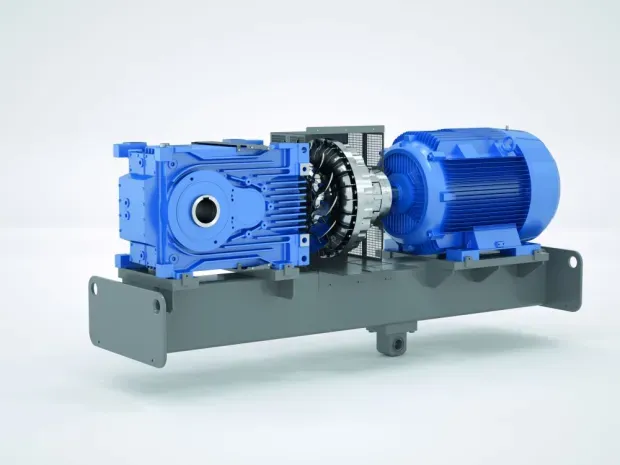
What a standard drive inspection covers
A standard geared motor inspection should not be limited to a quick look at the housing. A thorough check must combine mechanical, lubrication, thermal and operational assessment.
The most important inspection areas are:
- oil level and condition,
- seal tightness,
- operating temperature,
- noise and vibration,
- condition of mountings and foundation,
- correctness of the installation position,
- traces of overload,
- condition of the cooperating motor and accessories.
In its service materials NORD points, among other things, to checking the oil quantity, monitoring its quality, assessing the gear unit mounting, analysing the source of noise, verifying overload and confirming the correct mounting version in accordance with the manual.
The SPEC SERWIS service scope covers comprehensive geared motor inspection and repair, oil changes, drive condition assessment, fault rectification, component replacement, reading of NORD frequency inverter parameters and checks with a thermal imaging and endoscopic camera. The offer also includes drive inventories and initial inspections carried out at the customer's site.
In practice, a standard inspection should end with a short report. Such a document should contain not only a list of the faults noticed, but also an assessment of action priorities: what requires an immediate response, what can be scheduled for the next stoppage and which drives need more frequent monitoring.
Diagnostic tools in maintenance
Modern NORD maintenance relies less and less solely on a service technician's experienced ear. It is still important, but today it should be supported by measurements and data analysis.
The basis is temperature measurement and trend observation. A single reading can be misleading, whereas a series of measurements shows whether the drive operates stably or whether the temperature rises week by week. The same applies to vibration. In industrial diagnostics, standards from the ISO 20816 family serve to standardise measurements and compare them, and assessing the trend of changes is one of the key elements of interpreting machine condition.
Condition monitoring systems are also very important. Drive data can be recorded periodically or continuously, and in solutions based on a frequency inverter some of the information can be pre-processed by the integrated PLC. The manufacturer also indicates the possibility of using the data to monitor vibration and gear unit oil temperature.
In plant practice, particularly useful are:
- a thermal imaging camera,
- a vibration meter,
- a technical endoscope,
- oil analysis,
- diagnostics of frequency inverter and motor parameters.
This is important especially where the failure of one drive stops the entire line. In such places, diagnostics should not only be a reaction to a symptom, but part of a regular inspection plan.
How to create an inspection schedule
An effective drive inspection schedule should be simple, realistically implementable and linked to production priorities. An overly elaborate plan often ends with the maintenance team being unable to carry it out consistently.
First, it is worth carrying out a drive inventory. You need to establish which units operate in the plant, where they are installed, what function they serve, in what conditions they work and which of them are critical to production continuity. Such an inventory is also part of the SPEC SERWIS service catalogue and is a good starting point for further planning.
Next, the drives should be divided into three groups:
- critical to production,
- important but with technological workarounds,
- auxiliary.
A different check frequency is set for each group. Critical drives should have the shortest intervals and the fullest diagnostic scope. Auxiliary units can be checked less often, but still according to a defined scheme.
A good plan usually contains:
- drive number and location,
- geared motor or gear unit type,
- installation position,
- type of lubricant,
- date of the last inspection,
- date of the next check,
- fault history,
- the person responsible for execution.
In particularly demanding applications it is worth considering design solutions that reduce maintenance effort. For example, NORD indicates that the SAFOMI-IEC adapter for agitators increases operating reliability and lowers maintenance costs by reducing the elements exposed to leaks and wear.
Finally, the plan must be linked to the production calendar. The best schedule is one that takes technological stoppages, order seasonality and spare parts availability into account. Then inspections genuinely support production instead of competing with it for time.
How inspections affect production reliability
The greatest value of regular inspections is not the technical check itself, but predictability. The plant knows which drives are in good condition, which require observation and which need to be scheduled for overhaul or replacement.
This is particularly important for drives working in high-torque applications such as agitators, belt conveyors, mills, drums or crushers. MAXXDRIVE industrial gear units are designed for very high output torques and operation in harsh conditions, but it is precisely in such applications that the quality of monitoring and servicing has the greatest impact on the service life of the entire system.
A regular inspection also shortens response time in an emergency. The maintenance team has a measurement history, knows the weak points of a given unit and decides more quickly whether a seal replacement, mounting correction, oil change, brake repair or a larger overhaul is enough.
From an organisational perspective, a well-run inspection plan improves cooperation between production and maintenance. Operators know what to look out for, and service does not act only "after the alarm". This in turn translates into higher line availability, lower risk of quality losses and better cost control.
This is exactly why, in many plants, an inspection is no longer treated as a cost, but as a tool that safeguards the production result.
FAQs
Below you will find answers to the questions that most often arise when planning drive servicing in a plant.
How often should a NORD geared motor inspection be carried out?
It depends on the working conditions, load and the importance of the drive for the process. Operator checks can be performed daily or per shift, while technical inspections are usually planned monthly, quarterly or half-yearly. Oil intervals should be referred to the manufacturer's documentation.
What should a standard drive inspection cover?
The minimum is checking the oil level and condition, tightness, temperature, noise, vibration, mountings, installation position and signs of overload. In practice it is worth supplementing this with thermal imaging measurements, vibration diagnostics and an assessment of the cooperating motor's condition.
Does oil analysis really make sense in a production plant?
Yes, especially for drives working hard or critical to production. Oil analysis helps assess the condition of the lubricant and better choose the oil change time, instead of acting solely according to a rigid calendar. NORD recommends regular oil analysis especially for industrial gear units.
Which symptoms should bring an inspection forward?
The most important signals are rising temperature, oil leakage, unusual noise, increased vibration, reduced smooth running and frequent overloads. In such situations it is not worth waiting for the planned date, because a minor irregularity can quickly turn into a failure.
Can a frequency inverter help with drive diagnostics?
Yes. In NORD solutions, drive data can be used in condition monitoring, and in some configurations the frequency inverter can process data on the system condition and work with vibration and oil temperature measurements.
How can SPEC SERWIS support a plant with an inspection plan?
SPEC SERWIS supports plants with, among other things, drive inventories, initial inspections, geared motor condition assessment, oil changes, thermal imaging checks, endoscopic checks, reading NORD frequency inverter parameters and service work on NORD drives. In addition, SPEC SERWIS provides advisory support with selection and contact with NORD.