News · Mikołaj Skubina · 23.02.2026
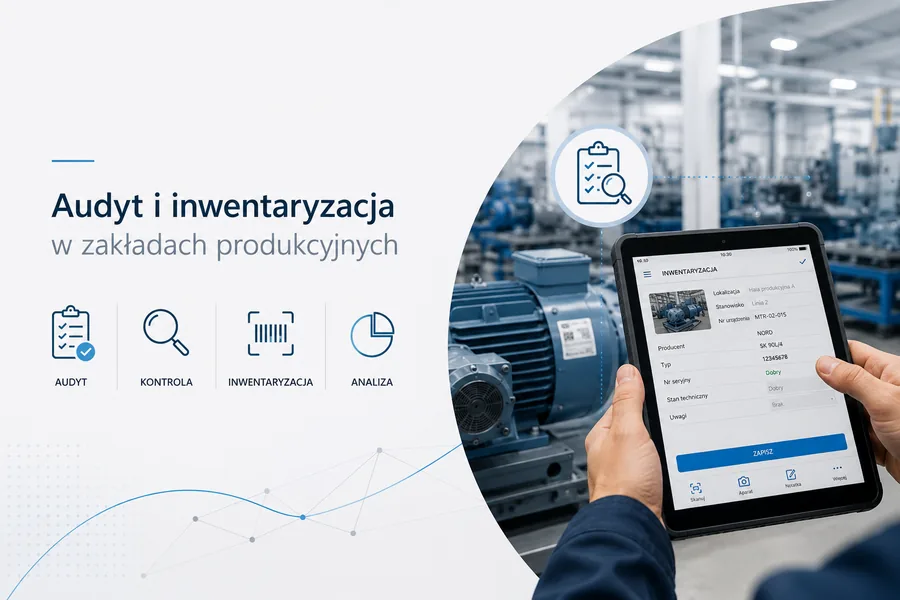
In many large enterprises, NORD drives are the standard – they work in conveyor belts, agitators, overhead cranes, packing lines and intralogistics systems. The problem starts when the machine fleet covers 300, 500 or more units. A lack of up-to-date documentation, uncontrolled spare parts stock levels and scattered technical data generate real costs.
This is exactly why a drive inventory and a technical audit of the machine fleet are the first step towards optimisation.
500 NORD drives – real challenges in a production plant
In large organisations supporting extensive production lines, we most often encounter the same problems:
- no uniform register of geared motors and industrial gear units,
- outdated data on installation positions (e.g. M1–M6),
- unknown oil change times,
- no information on frequency inverter parameterisation,
- excess spare parts in the warehouse or – conversely – their absence during a failure.
The effect? Downtime, capital frozen in the warehouse and difficulties in planning overhauls.
Drive inventory – the foundation of machine fleet management
A professional drive inventory is not just listing name plate numbers. It is a technical process covering:
- identification of the unit type (geared motor, industrial gear unit, asynchronous motor, synchronous motor),
- verification of power, torque and gear ratio,
- determination of the installation position and oil type,
- analysis of the operating condition (leaks, operating temperature, noise),
- checking of frequency inverter parameters.
In practice this means creating an up-to-date database covering all drive systems in the plant – from small 0.75 kW units to industrial helical or helical bevel gear units working with torques measured in tens of thousands of Nm.
Technical audit of NORD drives – what does the plant really gain?
An audit makes it possible to answer three key questions:
- Which drives are critical to production continuity?
- Which units require a planned inspection or oil change?
- How can the spare parts warehouse be optimised?
In the case of solutions such as helical inline or helical bevel geared motors or industrial MAXXDRIVE gear units, an incorrectly selected warehouse stock can mean hundreds of thousands of pounds of frozen capital.
A well-conducted audit makes it possible to limit stocks to genuinely critical parts, while protecting production against downtime.
Optimisation of the spare parts warehouse
In plants where 500 drives operate, we often find:
- 10–15 identical geared motors "just in case",
- a lack of key bearings or rotary shaft seals,
- outdated gear oils not compliant with the documentation.
After the audit it is possible to:
- create a list of critical parts (ABC),
- standardise drive types in new investments,
- reduce the number of variants of gear units and motors,
- plan inspections based on real data, not "by eye".
This is particularly important in industries such as logistics, food, bulk materials and transport systems with belt and screw conveyors.
SPEC SERWIS as an audit and advisory partner
SPEC SERWIS acts as technical and advisory support for plants using NORD drives. Our role is not limited to service activities.
In practice this means:
- carrying out a drive audit and inventory at the customer's site,
- assessing the condition of geared motors and industrial gear units,
- checking the parameters of frequency inverters,
- support in analysing technical documentation,
- advisory support in contact with the manufacturer and in the process of selecting new units.
SPEC SERWIS helps organise the machine fleet and prepare it for the plant's further development, minimising the risk of costly downtime.
An audit as part of the development strategy and large contracts
In B2B projects, especially with large service contracts, investors and boards expect:
- predictability of maintenance costs,
- a clear technical structure of the machine fleet,
- compliance with the manufacturer's documentation,
- readiness for expansion of production lines.
Well-organised drives in a production plant are not only a technical matter, but an element of the enterprise's financial and operational strategy.
Find out more
NORD geared motor for a feeder (e.g. 25 kW) – how to select a drive for industry?
Overview of NORD series: from SK1SI50 to powerful industrial units
Comprehensive NORD drive solutions – Authorised Partner SPEC SERWIS
FAQs – the most common questions about NORD drive audits
Below we answer the questions that most often arise in conversations with maintenance departments and technical staff.
Does a drive inventory require stopping production?
Not always. In many cases it is possible to carry out part of the work (reading name plates, visual checks, frequency inverter parameter analysis) without stopping the entire line. The scope of work is agreed individually.
How long does an audit take in a plant with 500 drives?
The time depends on the spread of the installation, the availability of documentation and the complexity of the systems. In practice, the process is divided into stages so as not to disrupt plant operation.
Does the audit cover frequency inverters?
Yes. We analyse the operating parameters of frequency inverters, check the basic settings and their compliance with the drive application.
What is the end result of an audit?
The result is organised drive documentation, a list of critical parts, inspection recommendations and an indication of potential cost optimisation areas.
If hundreds of units operate in your plant and you lack full control over their parameters, a drive audit and inventory is the first step towards stable and predictable maintenance. SPEC SERWIS provides technical and advisory support at every stage of this process.