News · Mikołaj Skubina · 04.03.2026
If a NORD geared motor heats up during operation, it does not always mean a failure. Every drive gives off heat, but when the temperature rises faster than usual, leaks appear, there is a smell of overheated oil, protective devices trip frequently or local "hot spots" appear on the bearings and housing, the cause must be found immediately, because prolonged overheating accelerates wear of the gear unit, seals and motor windings. Official NORD materials state clearly that when the temperature is too high you should check, among other things, the oil level, installation position, load, speed and ambient and cooling conditions.
In practice, overheating of a gear unit or motor usually does not have a single cause. Most often two or three factors overlap: too low an oil level, an incorrect installation position relative to the drive version, application overload, poor ventilation, incorrect frequency inverter settings or deteriorated bearing condition. NORD also states that when the operating position is changed, the oil quantity and the position of the level-check points and breather must be adjusted, otherwise the drive may be damaged.
What geared motor operating temperature is normal
There is no single "magic" temperature that is right for every geared motor, because the result depends on the gear unit type, load, speed, ambient temperature, type of grease or oil and the cooling method. So instead of asking only "how many degrees is the housing?", it is better to compare the drive's current operation with its earlier, stable state and with the conditions for which it was selected. A warm housing alone is not yet proof of damage.
Industrial motors are often found with class F insulation and class B temperature rise, which provides a thermal margin under typical operating conditions. Motor manufacturers also usually specify a standard ambient temperature of 40°C as the reference point for rated operation. This matters because a geared motor working in a hot hall, next to a furnace, under a sun-heated roof or in an enclosure without air exchange will naturally reach a higher surface temperature than an identical drive in a cooler location.
For maintenance teams, the most important thing is therefore not the number itself but the trend. If the drive ran stably for months and is now suddenly noticeably hotter, the temperature distribution becomes uneven, current draw increases or oil leaks, that is a warning sign. Fluke points out that the external surface temperature does not directly show what is happening inside the motor, but it is a good indicator of its condition, because as the inside of the drive gets hotter, the housing temperature rises too.
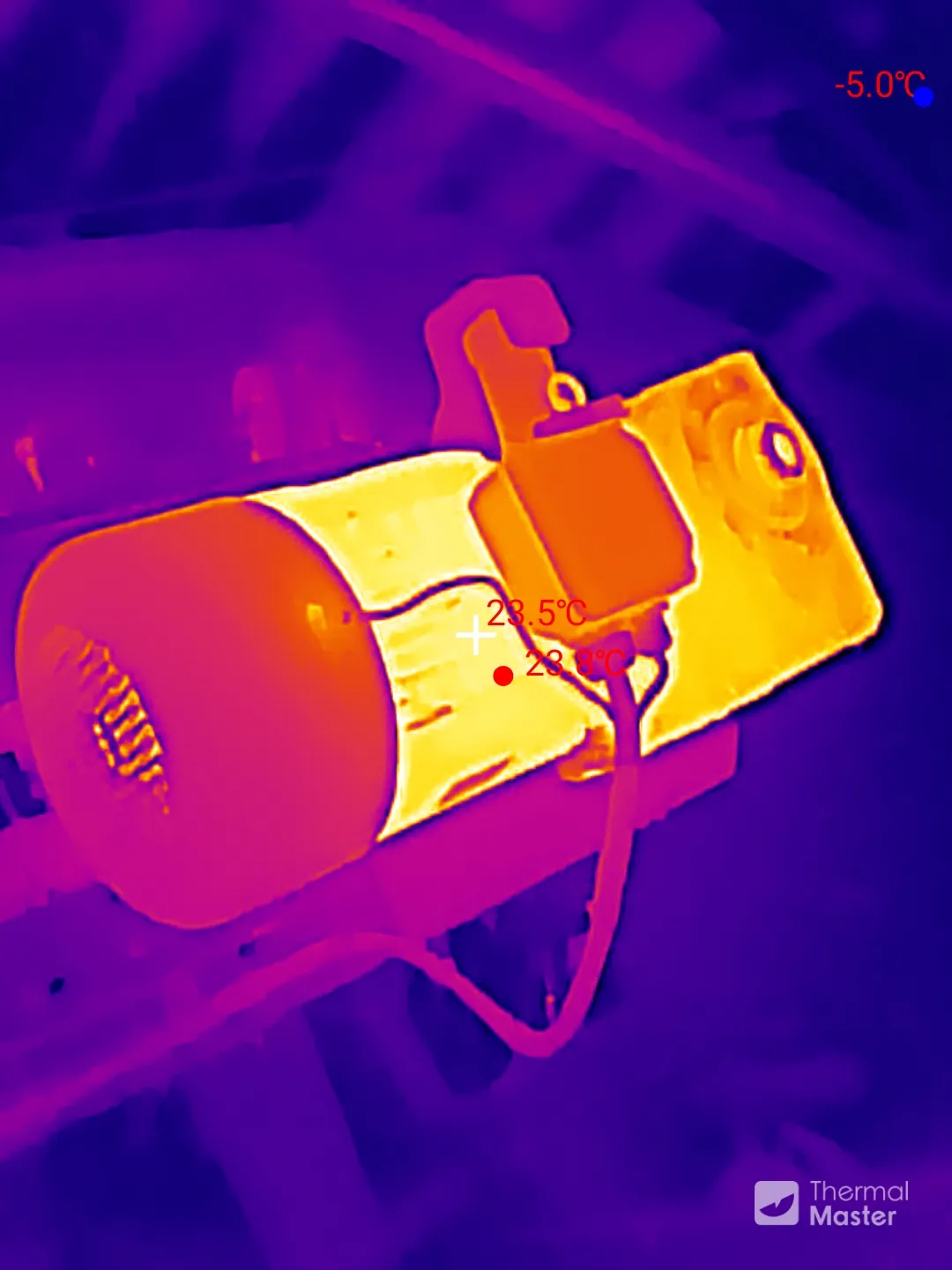
The most common causes of drive overheating
The first group of causes is operational problems related to oil and installation position. NORD recommends that when the temperature rises you start by checking the oil quantity, the conformity of the version with the installation position, and the load. This is logical: too little lubricant worsens lubrication and heat dissipation, and a non-compliant installation position can mean the oil does not reach where it should. SPEC SERWIS materials also emphasise that the oil type is marked on the name plate and that the installation position must be read in accordance with the manufacturer's documentation.
The second group is mechanical overloading of the gear unit or motor. Excessive load torque, a blocked conveyor, an incorrectly selected gear ratio, misalignment, coupling problems or worn bearings all increase losses and temperature. In its service materials, when the gear unit temperature is too high NORD tells you to check precisely for overload, and in the case of unusual vibration and noise also the mounting, coupling and frequency inverter parameters.
The third group is inadequate motor cooling. The official NORD FAQ indicates that when a motor gets too hot you should check the fan and fan cover, the cooling conditions, brake operation and, when running with a frequency inverter, also the minimum frequency and speed. This is a common scenario in practice: the drive is mechanically sound, but at low speeds from the inverter self-ventilation is not sufficient and the motor starts to overheat.
The fourth group is electrical and control errors. Excessive current draw, incorrect frequency inverter parameters, too frequent switching, a problem with the electromagnetic brake or a mismatch between the motor data and the inverter settings can all result in a temperature rise. NORD states directly that when operating with a frequency inverter the parameters must be matched to the name plate data, and that too frequent switching can lead to motor overload.
How to measure gear unit and motor temperature
The simplest method is an IR pyrometer, but remember that it measures surface temperature, not the inside of the drive. Fluke emphasises that the accuracy of non-contact measurement depends, among other things, on emissivity and ambient conditions. Shiny, metallic surfaces can be particularly misleading because they reflect infrared radiation and can understate or overstate the reading. That is why when measuring the gear unit housing or bearing covers it is best to always measure at the same point and under the same conditions, or to use a surface with higher emissivity, such as measuring tape.
A thermal imaging camera gives a more accurate assessment, especially when you want to compare the temperature on the drive and non-drive sides, the bearing areas, the fan area, the gear unit housing and the shaft outlet. Thermal imaging lets you see temperature differences and local overheating more quickly, not just a single number. Fluke recommends using thermal imaging both for diagnosing motor and drive problems and for predictive actions. This scope of diagnostics is also included in SPEC SERWIS services, which cover, among other things, thermal imaging and endoscopic inspection.
If you need a reference measurement, it is best to also use contact measurement, for example with a thermocouple sensor or a contact thermometer. Fluke lists such instruments as a solution for checking the temperature of motors and other industrial components. In practice, a good procedure looks like this: first a thermal imaging or pyrometer measurement, then confirmation with a contact measurement at the key point, and finally relating the results to load, current, speed and ambient temperature.
What to check when a geared motor overheats
The most sensible approach is to go step by step, without guessing. First check the name plate, the installation position and whether the drive is actually operating in the version for which it was ordered. NORD clearly warns that changing the operating version without the appropriate adjustments can lead to damage, because the oil quantity and breather position, among other things, must then be adapted. In our materials we also point out that the installation position is read from the designation on the name plate, e.g. M5.
Next, check the oil: level, condition, foaming, discolouration, smell and any leaks. When the temperature is worrying, NORD recommends checking the oil quantity, and in the case of unusual noises also assessing its condition and possibly carrying out an oil analysis. SPEC SERWIS reminds you that the type of lubricant and the oil change times must be selected in accordance with the name plate and the manufacturer's operating documentation.
Then move on to the cooling conditions and working environment. Check whether the motor fan is working properly, whether the cover is not clogged, whether the drive is not operating in an enclosure without airflow and whether there is an additional heat source nearby. NORD draws attention not only to cooling but also to impermissible ambient temperatures, including, for example, direct sunlight.
Finally, the load and control must be assessed. If the geared motor drives a conveyor belt, an agitator, a screw feeder or a system with frequent starts, the temperature rise may result from process overload or incorrect frequency inverter settings. Too high or too low a speed can raise the gear unit temperature, and with inverter operation the parameters should be verified against the motor data.
When overheating means a serious failure
Suspect a serious problem when temperature is not the only symptom. The most alarming signs are: a rapid temperature rise in a short time, hot spots at the bearings, oil leaks, strong vibration, increasing noise, a smell of overheated windings, frequent shutdowns by protective devices and increased current draw. NORD associates such symptoms with possible overload, bearing damage, problems with the windings, the brake or incorrect gear unit operation.
A situation where gear unit overheating goes hand in hand with a leak is particularly dangerous. Official NORD materials indicate that too high a gear unit temperature can cause pressure to build up inside the housing, which in turn can lead to leaks. This means that a thermal problem very quickly turns into a lubrication problem and then into accelerated wear of bearings and gearing.
If the drive operates at a critical point on the line, it is not worth waiting "for it to pass by itself". SPEC SERWIS carries out inspections, fault diagnosis, oil changes, fault rectification, thermal imaging checks and repairs of NORD drives, and also provides advisory support in selecting a solution and contacting the manufacturer. This is especially important when the problem may stem not only from damage to the geared motor itself, but also from the selection or application conditions.
How to prevent NORD drives from overheating
The most effective prevention starts with the basics: a documentation-compliant installation position, the right oil, a correct fill level and an activated breather after installation. The oil type and quantity should be read from the name plate or order confirmation, and the breather must be activated after installation and before commissioning.
The second pillar is regular inspections. SPEC SERWIS carries out geared motor inspections which cover, among other things, checking temperature, oil level and condition, tightness, bearings, seals, vibration and thermal imaging diagnostics. Such an inspection makes it possible to catch drives at increased risk of failure before the line stops.
The third pillar is correct control and matching the drive to the application. If the system runs with a frequency inverter, you need to watch the minimum speed parameters, switching frequency and conformity with the name plate data. If the process load has increased since the line was commissioned, service alone may not be enough and the selection of power, gear ratio or cooling method must be verified. It is not enough just to remove the symptoms – the real cause of the heating must be found.
If you see the geared motor's operating temperature rising, do not limit yourself to a single pyrometer reading. Compare the trend, check the operating conditions, oil, installation position, load and frequency inverter settings. And when you need broader diagnostics, be sure to write to us at SPEC SERWIS.
FAQs
Below you will find answers to the questions that most often arise when diagnosing an overheating geared motor.
Is it normal for a NORD geared motor to be warm during operation?
Yes, a warm housing alone does not have to mean a failure. Every geared motor gives off heat during operation because energy losses occur in the gear unit and motor. The problem arises when the temperature rises markedly compared with earlier, stable operation, or when it is accompanied by additional symptoms such as noise, oil leaks, vibration or protective shutdowns.
Why is a NORD geared motor heating up more than before?
Most often the reason is a change in operating conditions. This may be drive overload, too low an oil level, deteriorated cooling, an incorrect installation position, incorrect frequency inverter settings or wear of mechanical components. If the drive previously worked correctly and is now heating up more, it is worth comparing the current load and ambient conditions with the earlier state.
How do you check a geared motor's operating temperature?
The simplest way is to use a pyrometer or a thermal imaging camera. Measurements should always be taken at the same points, e.g. on the gear unit housing, at the bearings and on the motor frame. For greater certainty, it is good to compare the result with the ambient temperature, the drive's running time and the machine load.
Can too low an oil level cause a gear unit to overheat?
Yes, it is one of the most common causes. Too little oil worsens lubrication and heat dissipation from inside the gear unit. As a result, the operating temperature rises, and prolonged neglect can lead to accelerated wear of bearings, seals and gear wheels.
Can a frequency inverter cause a geared motor to overheat?
Yes, especially when the operating parameters are set incorrectly. Too low a speed can limit the effectiveness of motor cooling, and incorrect settings can increase the thermal load on the entire system. That is why, when operating with a frequency inverter, it is always worth checking the settings against the name plate data and application conditions.
How can you tell that overheating means a serious failure?
Situations in which a high temperature appears suddenly or rises very quickly are worrying. Alarming symptoms also include oil leakage, a smell of overheated windings, louder operation, increased vibration, frequent protective shutdowns and localised overheating at the bearings. In such cases, diagnostics should not be postponed.
What should you check first when a geared motor overheats?
It is best to start with the basics: oil level and condition, installation position, cooling conditions, drive load and frequency inverter settings. It is also worth checking whether the motor fan is working properly and whether the drive is operating in too high an ambient temperature. Such a quick check often makes it possible to catch the source of the problem without a long downtime.
How can you prevent NORD geared motors from overheating?
The basis is regular checking of the oil, tightness, operating temperature and mechanical condition of the drive. Correct installation, maintaining the proper installation position and periodic inspections also matter greatly. The earlier you catch worrying changes, the lower the risk of a costly failure and production line stoppage.