News · Mikołaj Skubina · 02.02.2026
If you type the phrase “nord sk1si50 geared motor” into a search engine, or you are looking for information on how drive identification works, you need to know that the key is always in one place – on the name plate! It allows you to unambiguously determine the gear unit type, the gear ratio (i), the motor power, the torque, the installation position and the type of oil.
In this article we show step by step how to read the designations – using the SK1SI50 model as an example – and what to pay attention to before contacting a service provider or the manufacturer.
What does a NORD name plate look like and where can you find it?
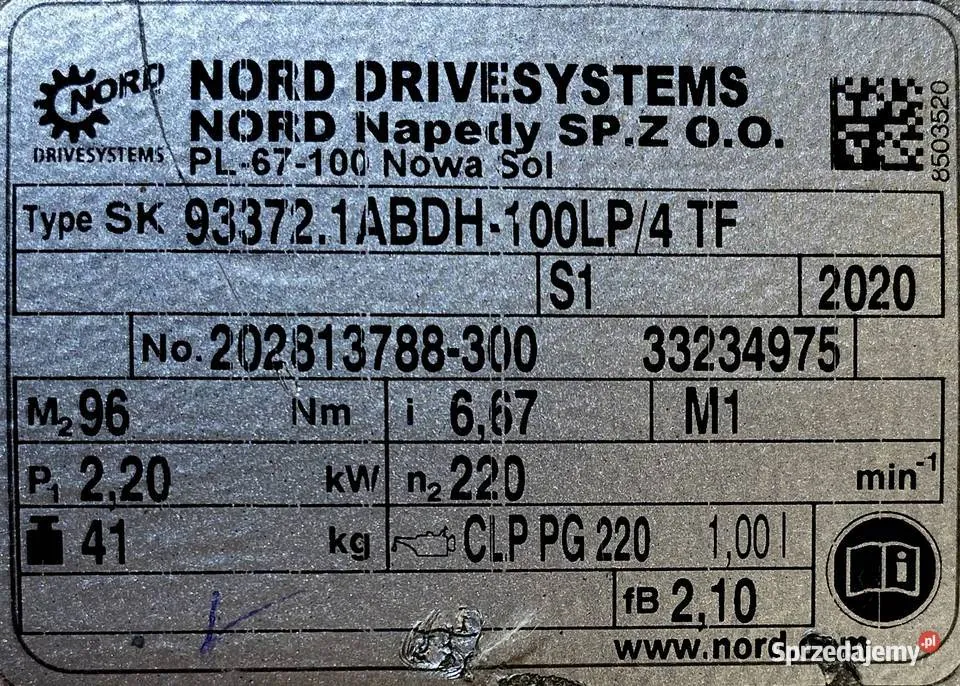
On NORD DRIVESYSTEMS drives, the name plate is placed directly on the gear unit or motor housing. Depending on the version, it may be riveted or in the form of a durable print.
You will find on it, among other things:
- the type and model designation (e.g. SK1SI50),
- the serial number,
- the gear ratio (i),
- the input and output speed,
- the torque,
- the motor power (kW),
- the installation position (e.g. M1–M6),
- the type of lubricant (e.g. CLP PG 220).
It is precisely this data that provides the full identification of the drive.
What does the SK designation mean in NORD geared motors?
In a model such as SK1SI50, the first element is the abbreviation “SK”.
In NORD nomenclature:
- SK – denotes the gear unit series (Getriebebau NORD),
- the following characters indicate the design type (e.g. helical, helical bevel, worm),
- the numbers define the mechanical size (housing size).
In practice, the designation makes it possible to determine:
- the type of gear unit used (e.g. helical, helical bevel),
- the available torque range,
- compatibility with a specific electric motor.
For example – in many industrial applications, such as a belt conveyor, an agitator or an overhead crane, the correct selection of the SK series has a direct impact on the durability of the entire system.
How to read the gear ratio (i) from the name plate?
The symbol i denotes the gear ratio of the gear unit.
The gear ratio is the ratio of the input shaft speed to the output shaft speed. If the name plate shows:
i = 25.43
it means that:
- the output shaft rotates 25.43 times slower than the motor shaft,
- the output torque is increased accordingly (taking efficiency into account).
The higher the gear ratio, the lower the output speed and the higher the torque.
This is a key parameter when analysing applications such as:
- screw conveyors,
- packaging lines,
- agitator drives,
- intralogistics systems.
Misinterpreting the gear ratio is one of the most common causes of drive operation problems.
Power (kW) and torque (Nm) – how to interpret them?
The name plate also shows:
- P (kW) – the power of the electric motor,
- M2 (Nm) – the torque at the gear unit output.
It is worth remembering:
- the motor power is not equal to the output torque,
- the torque depends on the gear ratio and the efficiency of the gear unit,
- at the same power, two different gear ratios will produce a completely different mechanical effect.
Example:
A 1.5 kW motor with a gear ratio of 10 will have a significantly lower output torque than the same motor with a gear ratio of 40.
That is why, for queries such as “nord sk1si50 geared motor”, power alone is not enough to select a replacement – full identification of the drive from the NORD name plate is necessary.
Installation position (e.g. M5) – why does it matter?
On the name plate you will find a designation such as:
M1, M2, M3, M4, M5, M6
This is the mounting position of the gear unit.
It defines:
- the orientation of the shaft,
- the arrangement of the housing,
- the level and method of lubrication.
Changing the installation position without verification can lead to under-lubrication of the bearings and overheating of the gear unit. This parameter should always be checked when modifying an installation.
Type of oil – where to look for it?
The name plate may carry a designation such as:
CLP PG 220
This is information about the type and viscosity class of the lubricant.
The type of oil depends on:
- the operating temperature,
- the mounting position,
- the type of gear unit,
- the load.
Oil should never be selected “by eye” – always follow the manufacturer's designation.
The most common mistakes in drive identification
In service practice, we most often encounter situations where:
- the user provides only the motor power,
- information about the gear ratio is missing,
- the installation position is omitted,
- the serial number is illegible.
All the data from the NORD name plate is needed for correct drive identification.
Find out more
Comprehensive NORD Drive Solutions – Authorised Partner SPEC SERWIS
Which oil for a NORD geared motor? A complete maintenance guide
NORD drives in production plants – audit and inventory
FAQs – the most common questions about the NORD name plate
Below we answer the questions that most often arise when trying to identify a model or order spare parts.
Can a replacement be selected from the SK1SI50 number alone, without the name plate?
Not fully. The series designation is not enough. The gear ratio (i), power, installation position and shaft version are also required.
What should I do if the name plate is illegible?
It is worth checking the machine's operation and maintenance documentation or the serial number. In many cases, the configuration can be reconstructed from the manufacturer's archived data.
Can the gear ratio be changed without replacing the entire gear unit?
No. The gear ratio is structurally linked to the set of gear wheels in the gear unit. Changing it requires a different mechanical variant.
Need help identifying a drive?
If you have trouble reading the data from the name plate, or you are not sure whether the SK1SI50 model is suitable for your application, SPEC SERWIS helps with drive identification and with contact with the manufacturer.
Thanks to our experience working with NORD drives, we:
- analyse the data from the name plate,
- verify the application parameters,
- support the selection of the right solution,
- provide advisory assistance with orders and spare parts.
Correct drive identification is the foundation of failure-free operation. And it all starts with one thing – an accurate reading of the NORD name plate.