News · Mikołaj Skubina · 13.05.2026
Yes – in many plants, replacing an old drive with a more energy-efficient one really does pay off. This is most visible where the system runs for long periods, often under a variable load, and accounts for a significant part of the electricity bill. The key, however, is calculating the entire system: the motor, the frequency inverter, the gear unit, the control method and the actual operating time.
How much energy drive systems consume
Drive systems are not a minor cost item. According to the IEA, motor-driven systems are the largest single consumer of electricity in the world, accounting for more than 40% of global electricity consumption. This shows why even a seemingly small improvement in efficiency can produce a noticeable effect over the course of a year.
In a production plant, drive energy consumption rises particularly where conveyors, fans, pumps, agitators and transport systems operate. The U.S. Department of Energy stresses that drive systems can achieve significant energy and cost savings through better management of system operation and the selection of higher-efficiency equipment.
From a maintenance practice perspective, this means one thing: the operating cost of a geared motor does not end with its purchase. Far more important is how much energy the drive draws over several years of continuous operation.
How drive efficiency affects costs
The most common mistake is to look only at the efficiency of the motor itself. In reality, what matters is the efficiency of the entire power train: the motor, the frequency inverter, the gear unit and the mechanical losses along the way. The European Commission introduced ecodesign requirements specifically for motors and frequency inverters, and additionally requires efficiency data to be stated at different load points, making it easier to optimise the efficiency of entire systems.
This matters, because a difference of a few percentage points in efficiency over thousands of operating hours a year translates into real money. Energy accounts for around 97% of the life-cycle cost of a typical motor. In other words: in many applications, it is not the purchase price that is the biggest expense, but the long-term electricity consumption.
This is particularly visible in variable-load applications. For centrifugal fans and pumps, reducing the speed by 20% can lower the input power demand by around 50%. That is exactly why a properly selected frequency inverter and sensible speed control often deliver a greater effect than simply replacing the motor with a newer model.
In practice, gear unit efficiency also matters. If the system is poorly selected, oversized or operates far from its optimum point, the bills rise even when the motor itself is formally "energy-efficient".
When it is worth replacing a drive with a new one
Replacing a drive usually makes sense when the current system runs long and regularly. The more operating hours per year, the easier it is to justify the modernisation economically. The same applies to applications with highly variable loads, where a frequency inverter can be used instead of throttling the flow, running on a bypass or continuously operating at an unnecessarily high speed.
Modernisation is also worth considering when the drive frequently overheats, is oversized, operates at low load or generates rising service costs. At Spec Serwis, we recommend a systems approach in which equipment selection and the way the system operates are subordinated to optimising the total cost of ownership, rather than merely minimising the purchase price.
The regulatory environment also matters. In the EU, since 1 July 2021, many three-phase motors rated from 0.75 to 1000 kW must meet at least efficiency class IE3. Since 1 July 2023, some motors in the 75–200 kW range must meet the IE4 level, and frequency inverters covered by the regulation's scope must achieve class IE2. This does not automatically mean that every older drive must be replaced immediately, but it shows the direction of the market: higher efficiency is becoming the standard, not an add-on.
It is also worth remembering that under the current direction of regulation arising from the EED Directive and the Polish Energy Efficiency Act, enterprises consuming more than 85 TJ of energy per year (approx. 23.6 GWh) will be required to implement a certified Energy Management System (e.g. ISO 50001), and entities exceeding 10 TJ per year will be subject to regular energy audits, which in practice further increases the importance of modernising drive systems and improving their efficiency.
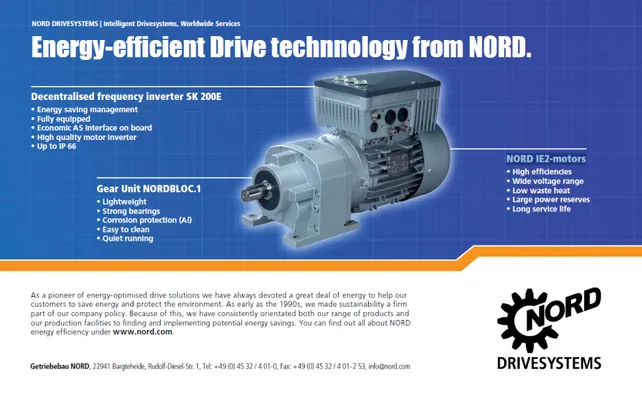
It is also worth noting that modern synchronous solutions are designed precisely to reduce energy consumption in continuous operation. NORD states that its IE5+ synchronous motors maintain a constant high efficiency across the entire control range and enable significant energy savings, particularly in drives that run without interruption.
How to calculate energy savings
The simplest calculation is worth doing before ordering the equipment. You do not need an elaborate financial model for this. A few figures from production and from the name plate are enough.
You calculate annual energy consumption as follows:
Energy consumption [kWh/year] = average power drawn [kW] × number of operating hours per year
If you want to compare the old and the new drive, use the relationship:
Electrical power drawn = useful power at the shaft / overall system efficiency
And then:
Annual saving [PLN] = (old system power – new system power) × operating hours × energy price
A second component can be added to this:
Total annual benefit = energy savings + avoided failure costs + lower maintenance costs
Finally, you calculate the simple payback period:
Payback = investment cost / annual benefit
or the classic ROI (Return on Investment):
ROI = (annual net benefit / investment cost) × 100%
Example. Assume the drive must deliver 5.5 kW of useful power. The old system has an overall efficiency of 82%, the new one 90%. At 6,000 operating hours per year:
- the old system draws approx. 6.71 kW,
- the new system draws approx. 6.11 kW,
- the difference is approx. 0.60 kW.
The annual energy saving is around 3,600 kWh. At a price of PLN 0.80/kWh, this gives around PLN 2,880 per year. If the additional cost of the modernisation is PLN 9,000, the simple payback is around 3.1 years.
This is still a conservative scenario, because it does not take into account the costs of downtime, failures, quality losses or maintenance team time. Yet it is precisely these elements that often mean the investment pays back faster than the energy meter alone would suggest.
Drive modernisation in production plants
In practice, drive modernisation should rarely mean merely swapping "motor for motor". The best results come from looking at the whole system: the load profile, speed, control method, gear unit efficiency, frequency inverter selection, starting method and environmental conditions. We also recommend this approach, pointing to systematic management of motors and drives as the basis for optimising the total cost of ownership.
In many plants, a cost-effective modernisation follows one of three scenarios. The first is replacing the old motor with a unit of a higher efficiency class. The second is adding or replacing a frequency inverter where the speed does not have to be constant. The third is rebuilding the entire drive system, when the current gear unit, gear ratio or control method cause unnecessary losses.
Applications running for an entire shift or around the clock have particularly high savings potential. NORD emphasises that high-efficiency synchronous motors are intended precisely for energy-intensive areas of application, including intralogistics, pumps and fans.
How to increase the energy efficiency of drives
First, it is worth measuring the baseline. Without data on operating time, load, current, temperature and actual speed, it is difficult to calculate a meaningful payback. The DOE recommends collecting and tracking energy data, establishing a baseline and carrying out a technical audit of the system before implementing savings measures.
The second step is matching the technology to the nature of the application. For variable-torque loads such as fans and pumps, speed control delivers a very large effect. For continuous operation, high efficiency at partial load and across a wide control range is important. This is exactly where modern synchronous motors and well-selected frequency inverters show their advantage over older solutions.
The third step is eliminating losses that are not obviously "electrical" at first glance. Poor alignment, an unsuitable gear ratio, oversizing, operating away from the design point or unnecessary flow throttling can eat up a considerable part of the potential savings. That is why drive energy efficiency is a topic not only for the purchasing department, but also for automation, maintenance and process engineers.
Finally, the most important question remains: will the modernisation pay off? In a great many cases, yes – but only if you calculate the whole system, not just the price of a new geared motor. This is where a thorough data analysis usually wins over intuition.
FAQs
Below you will find answers to the questions that most often arise when planning a drive modernisation.
Is replacing the motor alone enough to reduce electricity bills?
Not always. If the problem is poor speed control, oversizing or low efficiency of the entire system, replacing the motor alone may deliver less than expected. The biggest savings often appear when you also modernise the control and the way the drive operates.
What has a greater impact on ROI: the motor's efficiency class or the frequency inverter?
It depends on the application. In systems with variable flow or variable speed, the frequency inverter can be crucial, because it allows power draw to be limited by reducing speed. In applications running continuously at a fixed load, the higher efficiency of the motor itself and of the entire drive system may play a greater role.
How long does an energy-efficient drive usually take to pay back?
There is no single figure for all plants. The payback period depends on the number of operating hours, the energy price, the difference in efficiency, the investment cost and the failure and downtime costs that can be avoided. That is why it is best to calculate it individually, based on data from the specific line.
Does an older drive always have to be replaced because of EU regulations?
No. The EU regulation sets minimum requirements for equipment placed on the market or put into service within a defined scope. The mere fact that an older drive operates in a plant does not automatically mean an obligation to replace it immediately. The regulations are, however, a strong signal that the market is moving towards higher efficiency.
Should ROI take only energy into account?
It should not. Energy alone is the foundation of the calculation, but a full analysis should also include the costs of service, planned downtime, output losses, process quality and failure risk. We recommend looking at the total cost of ownership, not just the purchase price of the equipment.