News · Mikołaj Skubina · 25.02.2026
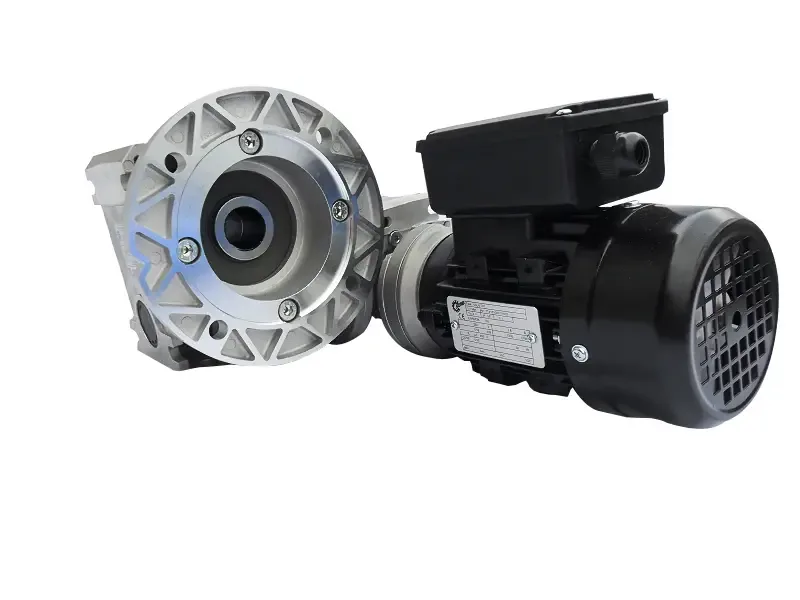
Selecting a geared motor at 25 kW is an engineering process in which the key factors are torque, gear ratio, the fB service factor and the real load conditions. In the case of feeders (e.g. belt or screw feeders), incorrectly estimating the drive parameters leads to overheating, excessive gear unit wear and unplanned downtime.
Below we present a specific case study and a procedure that makes it possible to select a NORD geared motor for a 25 kW feeder in a safe and repeatable way.
Case study: NORD geared motor for a 25 kW feeder in the bulk materials industry
Design assumptions:
- Belt feeder transporting bulk material
- Motor power: 25 kW
- Continuous 24/7 operation
- Frequent starts under load
- Dusty environment
In applications of this type, the drive must provide high output torque at a relatively low shaft speed, while withstanding the dynamic loads that occur when starting with a full material load.
Depending on the required shaft alignment and mounting space, the most commonly used are:
- helical inline geared motors,
- helical bevel geared motors,
- in applications with very high torques – industrial gear units.
NORD DRIVESYSTEMS offers both compact geared motors and high power density MAXXDRIVE industrial gear units.
Step 1: Calculating the required torque
The basic drive parameter is the torque at the output shaft.
The output torque can be estimated using the formula:
M = 9550 × P / n
where:
P – power [kW]
n – output shaft speed [rpm]
Example:
If the feeder runs at 60 rpm:
M = 9550 × 25 / 60 ≈ 3979 Nm
However, this is a theoretical value. In practice, the following must be taken into account:
- gear unit efficiency,
- starting torque,
- temporary overloads,
- the fB service factor.
Step 2: The fB service factor – crucial at high power ratings
In applications such as a conveyor belt or a screw conveyor, selecting a geared motor without taking the fB service factor into account is a serious mistake.
The fB factor depends on:
- the nature of the load (light / medium / heavy),
- the number of starts per hour,
- the operating time per day,
- the uniformity of the load.
For continuous 24/7 operation with heavy starting, fB may range from 1.4 to 1.8.
This means that the actually required torque will be:
3979 Nm × 1.6 ≈ 6366 Nm
It is this value that should be adopted for gear unit selection, not the torque resulting solely from the motor power.
Step 3: Selecting the gear unit type
At 25 kW and a high output torque, the following are most commonly considered:
Helical inline geared motor
- high efficiency,
- compact design,
- good performance under continuous load.
Helical bevel geared motor
- the ability to change the shaft direction,
- high torque in a compact design,
- often used for feeders and conveying systems.
Industrial gear unit
For very high torques (tens of thousands of Nm), a separate industrial gear unit and electric motor are used. This is a typical solution for agitators, mills and heavy-duty applications in the bulk materials industry.
Step 4: Drive parameters that must not be overlooked
At high power ratings, torque alone is not enough. In practice, we also analyse:
- the installation position (e.g. M5 – in accordance with the name plate),
- the permissible radial and axial forces on the shaft,
- ambient conditions (dust, moisture, temperature),
- the motor cooling method,
- the possibility of using a frequency inverter.
In 25 kW applications, a frequency inverter is often used, enabling a soft start, limiting inrush currents and providing speed control.
The difference: standard geared motor vs industrial gear unit
At 25 kW, the boundary between a classic geared motor and an industrial gear unit starts to become significant.
A geared motor is a compact assembly: an electric motor + a gear unit in a single housing.
It works well in typical conveying applications.
An industrial gear unit is a separate gear unit with a very high output torque (even above 100,000 Nm), designed for extreme loads and shock-duty operation.
In applications with a heavy material load, difficult starting and continuous operation, it is often safer to consider an industrial solution.
What does professional geared motor selection look like?
The design process includes:
- An analysis of the mechanical parameters of the installation.
- A torque calculation taking fB into account.
- Selection of the gear ratio.
- Verification of the loads on bearings and shafts.
- A check of the operating conditions (temperature, IP rating, corrosion protection).
- Selection of the control system (if required).
SPEC SERWIS acts as consultancy and sales support in contact with NORD DRIVESYSTEMS, helping with the correct selection of a geared motor for a 25 kW feeder and other industrial applications. The key point is that the drive should be selected for the real loads, not solely for the motor's rated power.
Find out more
NORD geared motor for a feeder (e.g. 25 kW) – How to select a drive for industry?
Comprehensive NORD Drive Solutions – Authorised Partner SPEC SERWIS
NORD drives in production plants – drive audit and inventory
FAQs – the most common questions when selecting a 25 kW drive
Below we answer the questions that most often arise when designing a drive for a feeder or conveyor.
Does 25 kW of power automatically mean a specific torque?
No. The torque depends on the output speed and the gear ratio. The same 25 kW motor can generate completely different shaft torques depending on the reduction.
Does the fB service factor always have to be taken into account?
Yes. In continuous operation, with heavy starts and variable loads, omitting fB leads to undersizing the gear unit and shortening its service life.
When should an industrial gear unit be considered instead of a classic geared motor?
When the required torque is very high, there are load shocks or the application operates in heavy-duty mode 24/7.
Is a frequency inverter necessary at 25 kW?
Not always, but in many applications it improves operating smoothness, enables speed control and limits mechanical overloads during starting.
Summary
Selecting a NORD geared motor for a 25 kW feeder requires an analysis of:
- the actual torque,
- the fB service factor,
- the gear ratio,
- the ambient conditions,
- the nature of the load.
The most common mistake is selection "by power", without recalculating the torque for heavy-duty operation.
In industrial applications, correct drive selection determines the durability of the entire installation – which is why the process should be carried out on an engineering basis, not by catalogue alone.