News · Mikołaj Skubina · 29.04.2026
A well-planned spare parts warehouse is not about buying everything "just in case". It is about keeping those elements that genuinely determine line stoppage time: parts for critical drives, components with longer delivery times and elements that wear predictably. It is precisely this approach that best supports downtime minimisation and limits the cost of failures.
In practice, the maintenance department should not build a warehouse "blindly", but combine three areas: application criticality, fault history and parts availability from the manufacturer. Manufacturers constantly emphasise that failures and technical problems cost time and money, and that fast parts and service support has a direct impact on drive continuity.
Why a parts warehouse shortens downtime
The biggest loss in a drive failure rarely stems from the price of the part itself. Usually more costly is the lack of production, operator downtime, disruption of internal logistics and the risk of delivery delays. ABB points out directly that a lack of needed parts during a planned shutdown or a failure increases downtime and logistics costs, and that planning critical parts in advance is the most effective and economical way to protect plant reliability.
This is also clearly visible in NORD's approach to plant maintenance. The manufacturer notes that a strategy based solely on reacting after a fault occurs is short-sighted, because the costs of clearing failures usually exceed the apparent savings from limiting preventative measures. Regular servicing, on the other hand, means predictable costs, high system availability and the ability to plan shutdowns.
In practice, a parts warehouse works best when it is part of a larger system: fault diagnosis, service planning and fast identification of components. NORD enables parts to be identified by serial number and provides parts lists for a specific unit, while Fluke emphasises that condition monitoring helps move from a reactive to a predictive model, lowers maintenance costs and improves the response to downtime. This means one thing: the cheapest part is the one you have correctly selected before a failure occurs.
Which drive parts wear out most often
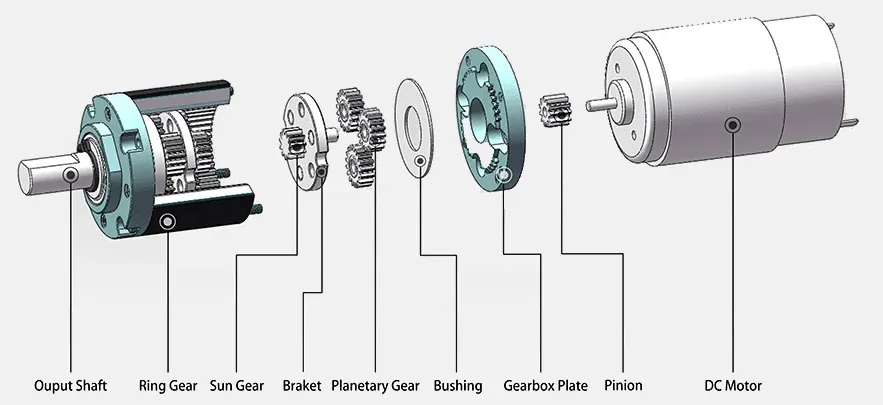
In mechanical drives, the same groups of elements come up again and again. During repairs NORD replaces, among other things, seals, bearings and gear oil, and its parts shop shows for a given unit, among other things, bearings, seals, gear unit elements and gaskets. This is a good starting point for determining which items should be considered critical drive parts.
Contamination and sealing quality have a major impact on service life. SKF describes directly that an ineffective seal admits particles into the bearing, which leads to indentations on the raceways, surface fatigue and, consequently, spalling and loss of serviceability. The selection of the right lubricant, the right quantity and the right interval is crucial for durability.
For this reason, the highest-priority parts list usually includes bearings, rotary shaft seals and other shaft seals, gaskets, oils and greases compliant with the documentation, as well as elements related to maintaining the tightness and cleanliness of the system. This is particularly important in dusty, humid, wash-down or continuously operating environments, where even a slight deterioration in tightness accelerates the degradation of the assembly.
The second group is elements of the motor equipment and the brake drive. NORD recommends checking the fan, fan cover and motor bearings in the case of unusual noise and vibration, and in motors with a brake, monitoring the operation of the brake. In the case of brake problems, the manufacturer indicates, among other things, checking the rectifier, the air gap and lining wear. This clearly shows that in braking applications, brake components should be treated as warehouse items of elevated importance.
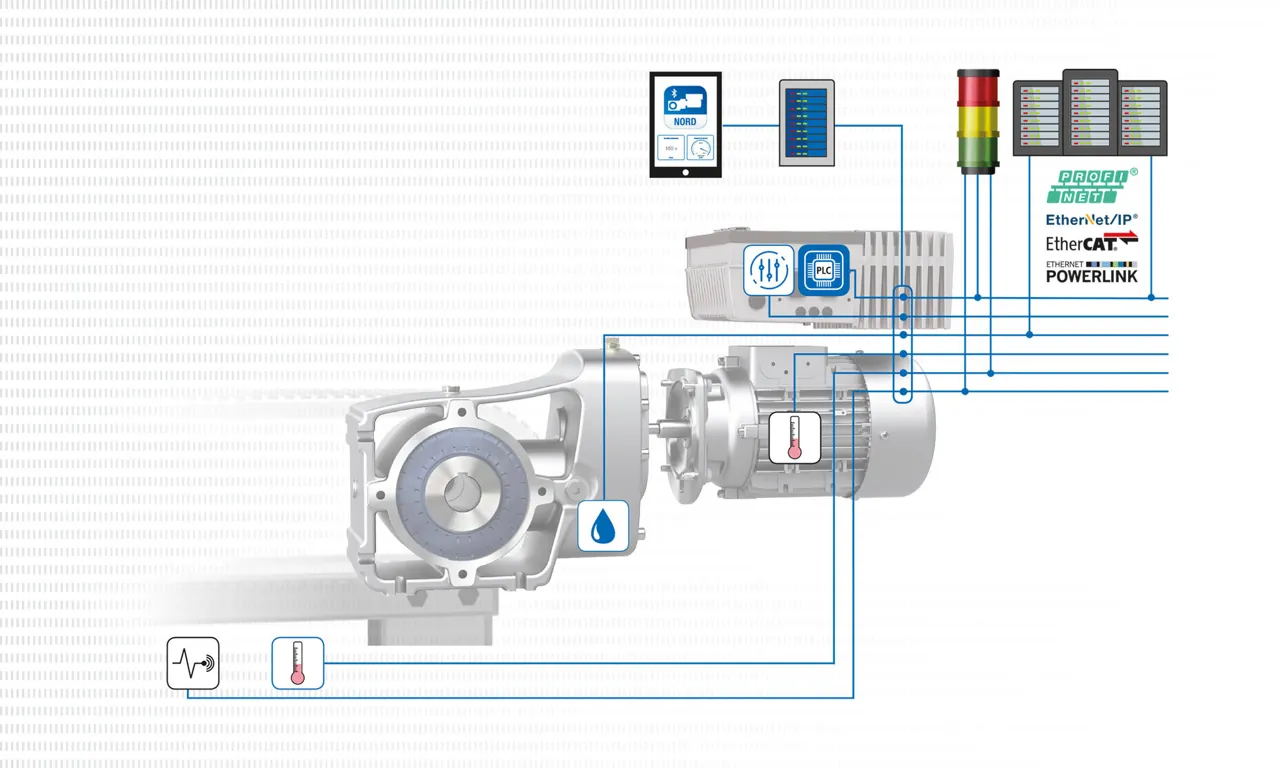
The third group concerns drive electronics. In systems with frequency inverters and starters, it is worth looking not only at the motor and gear unit itself, but also at the control elements, because incorrect parameters, a fault in the motor cable or a failure of the inverter itself can immobilise a line just as effectively as mechanical damage. NORD also emphasises that its drive electronics support remote condition monitoring and integrate safety and brake control functions.
The minimum parts set for the maintenance department
Not every company needs a large warehouse. In many plants, a minimal but well-thought-out set is sufficient, matched to the most heavily loaded and most critical drives:
- bearings for key geared motors and motors,
- shaft seals, gaskets and elements protecting against leakage and contamination,
- gear oil and lubricants compliant with the documentation,
- brake wearing parts in drives with braking,
- a fan or fan cover for the most important motors,
- a spare frequency inverter, starter or even a complete geared motor for production bottlenecks.
The most important thing is not to treat all drives identically. An auxiliary drive that can be stopped for a few hours requires different protection from a unit working on the main conveyor, an agitator or at a sensitive packaging point. That is exactly why a spare parts warehouse should be built around criteria such as the impact of a failure on production, delivery time, the possibility of replacing the part with another unit, and the history of actual damage.
In practice, it is also a good solution to keep one complete spare unit for those drives that are a process bottleneck or have an unusual configuration. NORD offers 24/7 support for spare parts and replacement drives, but even with an efficient supply chain, a local reserve is still the fastest way to reduce stoppage time to a minimum.
How to plan a spare parts stock
Stock planning should start with identifying the drive, not the name of the part. NORD enables parts to be searched by serial number or order number and shows the list of parts assigned to a specific unit. This is very important because the same drive type can come in different versions, with different seals, brakes, electronics or mounting variants.
The second step is to determine the risk. ABB draws attention to the analysis of warehouse gaps, risk factors, life-cycle status and alternative options. Simplified, this means that for every important part it is worth answering a few questions: how long is the delivery time, what will happen to production after it fails, whether interchangeability exists between stations, and whether the item is not already entering the final phase of its life cycle.
The third element is proper storage. SKF emphasises that bearings should not be overstocked, and the FIFO principle (First In First Out) helps keep "fresh" components on the shelf. This is particularly important for bearings with seals or shields, because they are factory-greased and grease has a limited shelf life. A badly managed stock can therefore generate costs even when a part never makes it into the machine.
The fourth element is combining stock levels with diagnostics. NORD Smart Check covers, among other things, an assessment of noise, surface temperature, brake wear, oil level and reading of frequency inverter parameters. Fluke, in turn, indicates that continuous monitoring allows the source of a problem to be identified faster and improves the response to downtime. Thanks to this, the warehouse ceases to be a random collection of parts and becomes a tool of planned plant maintenance.
Original parts vs replacement parts
In the field of industrial drives, the purchase price of a part is only a fraction of the total cost. NORD emphasises that original manufacturer parts allow the unit to keep operating in line with the original design intent, and OEM (Original Equipment Manufacturer) parts help limit unplanned downtime, increase reliability, lower the Total Cost of Ownership and improve safety and compliance.
This does not mean that every replacement part is a mistake by definition. The problem arises when differences in material, bearing class, seal geometry, brake parameters or workmanship quality only come to light in operation. Then the apparent purchasing saving can quickly turn into a higher cost of failure, longer MTTR and secondary damage. That is why in critical drives, in heavy-duty applications and wherever repeatability of operation matters, it is worth keeping to the OEM standard.
The safest approach is simple: original parts for critical drives and for elements affecting tightness, durability and safety; verified replacement parts only where their technical equivalence has been confirmed and documented. This approach protects continuity of operation better than a "let's buy the cheapest and see" policy.
How to reduce drive maintenance costs
The biggest savings usually do not come from maximally limiting stock, but from the right balance between prevention, diagnostics and parts availability. NORD points out directly that preventative replacement of wearing parts limits the risk of unplanned downtime, reduces wear on other elements, increases system availability and extends the service life of the product.
The second source of savings is moving from reactive to predictive maintenance. Condition monitoring helps reduce maintenance costs, improves the response to downtime and supports the transition to condition-based servicing. The earlier the maintenance team sees rising vibration, temperature or deteriorating operating parameters, the easier it is to plan a part replacement at a convenient time instead of firefighting in the middle of a shift.
The third element is data order. Drive serial numbers, assigned parts lists, minimum stock levels, delivery times and replacement history should be recorded in one place. Such order shortens not only machine downtime, but also people's response time. This is exactly where SPEC SERWIS can genuinely support your plant: with a drive inventory, an assessment of technical condition, identification of critical parts, fault diagnosis and contact with NORD when selecting the right components.
FAQs
Below you will find answers to the questions that most often arise when planning drive parts.
Should every drive have a complete set of parts on the shelf?
No. Stock should be built primarily for critical drives, i.e. those whose failure stops the line or generates a high cost of stoppage. ABB recommends planning critical parts in advance and analysing warehouse gaps, risk and life-cycle status, rather than evenly "spreading" the budget across all devices.
Is it better to keep individual parts or a whole spare geared motor?
It depends on the criticality of the station and the replacement time. For many applications, bearings, seals, oil and brake elements are sufficient, but for production bottlenecks a complete spare unit makes sense because it gives the shortest restoration time. NORD supports both spare parts and replacement drives, which confirms the sense of this approach.
Which parts are most often worth considering critical?
Most often these are bearings, seals, gaskets, gear oil and brake elements in drives with braking. NORD indicates these groups in its service and parts materials, and SKF shows that improper sealing and contamination very quickly lead to bearing damage.
Are original parts really worth the higher price?
In critical drives, usually yes. ABB indicates that OEM spare parts help limit unplanned downtime and lower the total life-cycle cost, and NORD emphasises that original parts allow the unit to keep operating in line with the manufacturer's assumptions.
How can you limit capital frozen in a parts warehouse?
Don't stock everything and don't keep excessive levels without control. Avoid overstocking and use FIFO, especially for factory-greased bearings; as SPEC SERWIS we also recommend analysing risk, gaps and parts status instead of mechanically increasing stock.
Does diagnostics really reduce the need for a large warehouse?
Yes, because it allows a problem to be detected earlier and the replacement to be planned better. Condition monitoring improves the response to downtime and lowers maintenance costs, and NORD combines condition monitoring with a predictive approach to service and increasing drive availability.