News · Mikołaj Skubina · 01.04.2026
A well-selected drive for a conveyor belt does not start with choosing the motor power alone. First you need to establish the required belt speed, the system load, the drive drum diameter, the starting conditions and the real torque the conveyor must transmit to the output shaft. Only then can you sensibly determine the gear ratio selection and choose the right geared motor. In conveyor applications NORD uses, among others, helical bevel geared motors for high gear ratios and torques, as well as larger industrial gear units for heavy transport systems.
How a conveyor belt and its drive work
A conveyor belt converts the rotary motion of the motor into the linear motion of the belt. In practice, the motor drives the gear unit, the gear unit reduces the speed and increases the torque, and the output shaft drives the drum. It is on the drive drum that the force is created which moves the belt with the material. For longer routes, higher throughputs and horizontal or inclined transport, conveyor belts are very often the primary solution, and with material fully at rest on the belt the power requirement can be more favourable than in other continuous transport systems.
From the drive selection point of view, four elements matter most: the required belt speed, motion resistance, starting conditions and drum geometry. They decide whether a compact geared motor will suffice or whether a more elaborate configuration with an industrial gear unit, coupling or frequency inverter will be needed. The manufacturer NORD indicates that 2- and 3-stage drives are used in this application group to achieve the required belt speed, and at higher loads and thermal requirements MAXXDRIVE solutions are used.
In practice this means one thing: you do not select a drive "by eye" based only on belt width or on the power of the previous machine. Two conveyors of similar length may require completely different torque if they differ in drum diameter, incline angle, type of transported material or start-stop frequency.
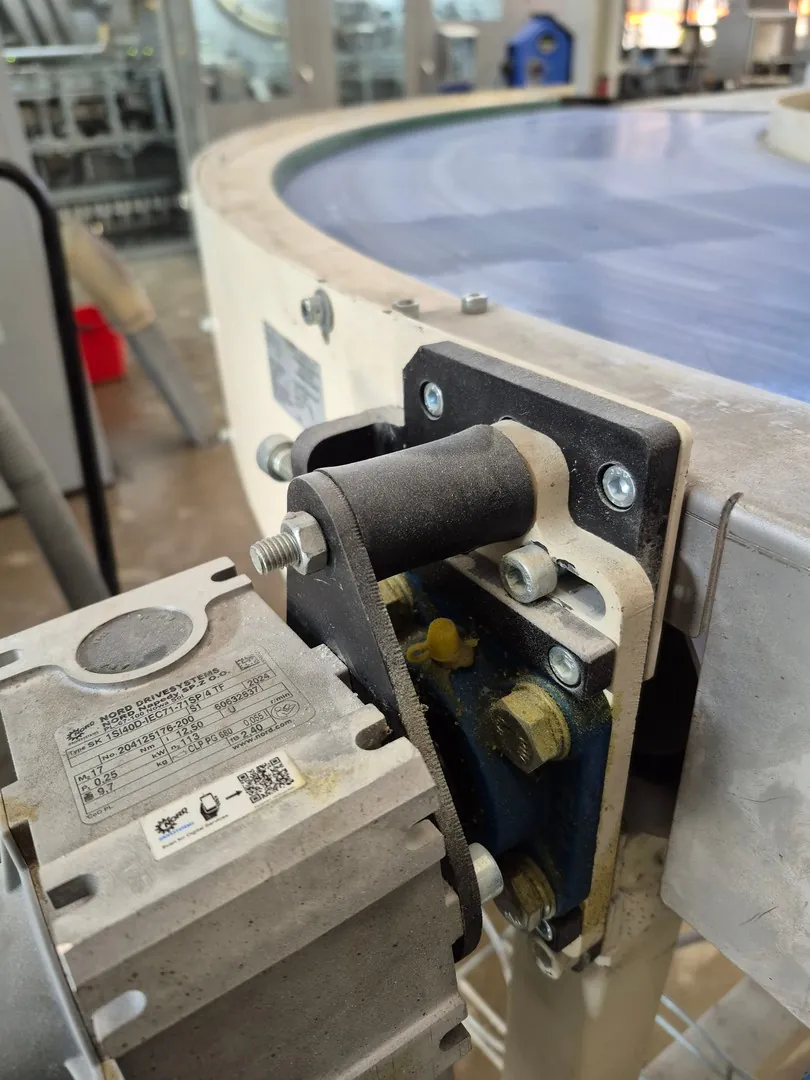
How to calculate the required torque
The basic mechanical relationship is simple: the torque on the output shaft results from the force acting on the drum circumference and its radius. In practical terms this can be written as:
M = F × r
where:
M – torque on the drum [Nm]
F – peripheral force needed to move the belt [N]
r – drive drum radius [m]
This is a good starting point, but first the force itself must be estimated. It includes rolling resistance, friction, the effect of the incline, the belt mass, the mass of the transported material and the starting conditions. This is exactly why, when designing conveyors, the question "how many kW does the motor have" is not enough, because the selection is decided above all by the required output torque.
A second useful relationship connects torque, power and speed. The power of rotary motion can be expressed by the formula P = Tω, and after converting to the practical units used in drives we obtain the relationship:
M [Nm] = 9550 × P [kW] / n [rpm]
This formula is very useful for verifying whether the selected motor and gear unit will actually deliver the required output torque. However, remember that for starting and overloads the rated torque alone is not always sufficient. ABB emphasises that in constant-torque applications drive selection should take the real shaft load into account, and Siemens points out that when speed rises above the rated range, torque falls if we operate at constant power. This is important especially when the conveyor is to be inverter-controlled over a wide speed range.
In practice, calculations are best carried out in this order:
- establish the required belt speed,
- calculate the drum speed,
- estimate the peripheral force and torque on the drum,
- only then select the motor power and gear ratio.
This way you neither oversize the drive nor choose a system that only starts on an empty belt.
How to select the gear unit ratio
If you know the required belt speed, you can calculate the necessary drive drum speed. For peripheral motion the relationship is as follows:
v = π × D × n / 60
or, after rearranging:
n = 60 × v / (π × D)
where:
v – belt speed [m/s]
D – drum diameter [m]
n – drum speed [rpm]
Once you know the drum speed, you determine the gear ratio from the relationship between the motor speed and the required output speed:
i = n_motor / n_output
If you use a reduction gear unit, the output speed will be lower and the torque will rise. This relationship is well described by the formula for torque after reduction:
M_out = M_in × i × η
where η is the gear unit efficiency. At the same time, the output speed decreases in inverse proportion to the gear ratio.
This is where the real gear ratio selection is most often decided. If you choose too small a ratio, the belt will be too fast and the torque on the drum too low. If you choose too large a ratio, you will get high torque, but the transport speed will fall below the process requirements.
In conveyor belts, helical bevel geared motors often work well because they combine high gear ratios and large torques with a compact design. NORD directly indicates them as a solution particularly suitable for conveyor belts, intralogistics and packaging. For heavy conveyors and bulk material applications, MAXXDRIVE XT industrial gear units, designed for high loads and thermal requirements, are also a sensible direction.
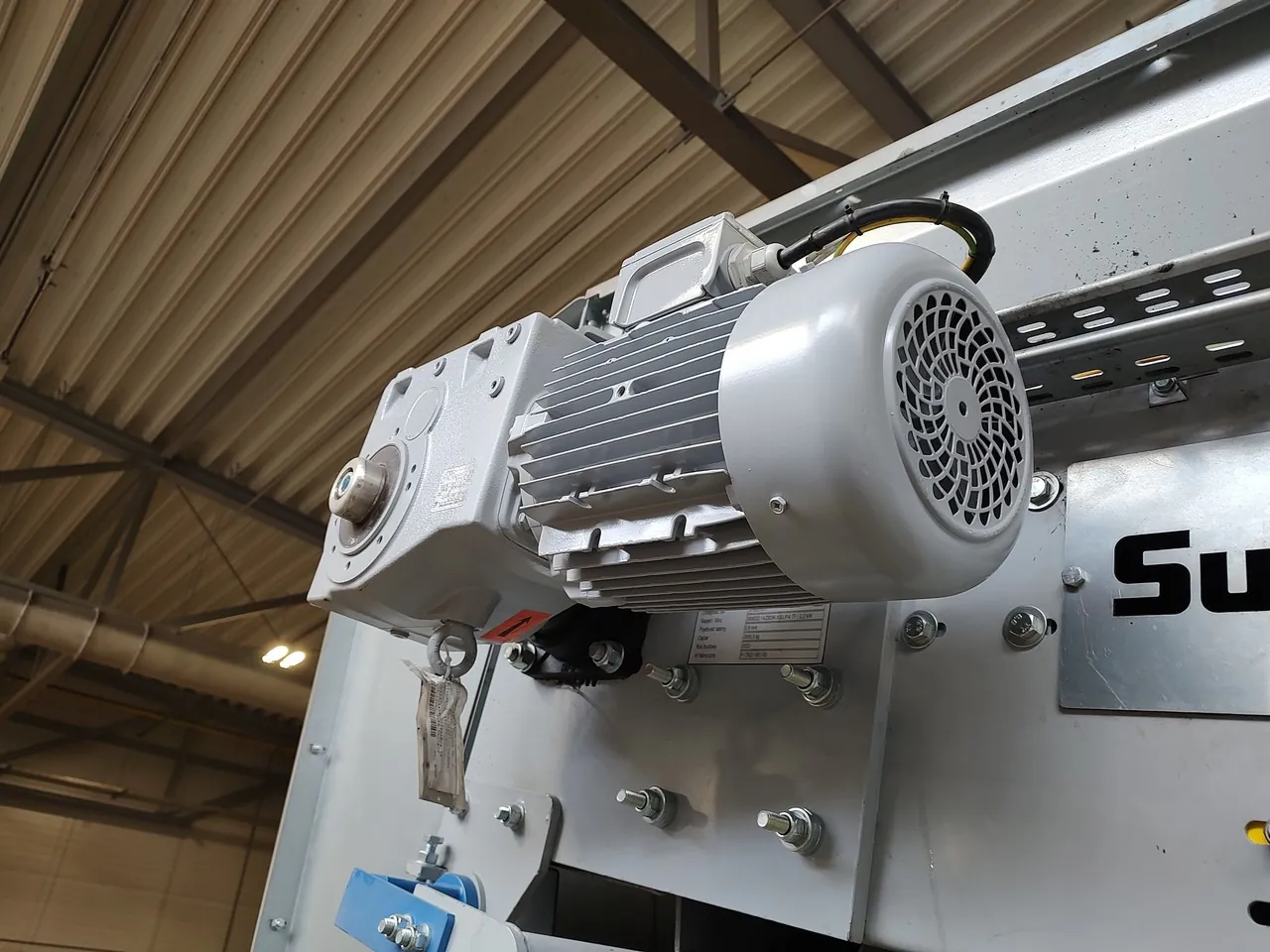
The most common drive selection mistakes
A very common mistake is selecting a geared motor solely by motor power. Power matters, but without reference to speed and torque it says too little. Two 3 kW motors can behave completely differently if they have different rated speeds or work with a different gear unit.
The second mistake is ignoring the starting conditions. An empty conveyor and a loaded conveyor do not present the same resistance. The problem grows when the system starts frequently, works on an incline, transports bulk material of variable density or operates in a dusty environment. Then a torque margin and the right service factor stop being an extra and become a necessity.
The third mistake is failing to take the drum diameter into account. This parameter directly affects the required torque. The larger the drum radius, the more torque is needed at the same peripheral force. In practice, it is the change of drum diameter that can completely change the selection result, even though the belt length and width remain unchanged.
The fourth mistake concerns speed control. If the conveyor is to work with a frequency inverter, remember that when the frequency is increased above the rated range the torque may fall. At low speeds, in turn, motor cooling and the load characteristic become critical. In such a system the mere declaration "there will be an inverter" is not enough; the drive's full operating range must be taken into account from the outset.
The fifth mistake is copying the old solution 1:1. Even if the previous drive "worked", it does not mean it was well selected. It often worked at the cost of higher temperature, greater current draw, faster bearing wear or starting problems in winter.
How to increase the service life of a conveyor drive
Drive service life starts with correct selection but ends with operation. Even a very good geared motor will work for a shorter time if the system is poorly aligned, overloaded or started with an incorrect acceleration ramp.
Limiting overloads and shocks matters most. In many applications a frequency inverter or a softer start helps with this. NORD also points to the importance of thermally optimised solutions for heavy conveyor drives. It is not only about the torque itself, but also about the ability to dissipate heat during long operation. This is exactly why, in heavier applications, gear units with additional fans, housing ribbing and large roller bearings are used.
Basic servicing is also very important. You need to watch the quality and level of the lubricant, the installation position, the temperature and the condition of the seals and bearings. At SPEC SERWIS we emphasise how important, among other things, checking the condition of geared motors, oil changes, reading frequency inverter parameters and thermal imaging checks are, which clearly shows that drive durability depends not only on the catalogue, but also on supervision in operation.
In practice it is also worth regularly checking:
- the operating temperature of the gear unit and motor,
- the condition of the drum, couplings and shaft,
- belt tension and tracking,
- start frequency,
- load changes over time.
The longest-working drives are those that are not constantly loaded to the catalogue limit. A safe design margin and correct operation usually cost less than line downtime.
Example NORD drive configuration
Assume a conveyor belt that is to run at 0.8 m/s, with a drive drum diameter of 0.2 m. The peripheral relationship then gives approximately:
n = 60 × 0.8 / (π × 0.2) ≈ 76 rpm
If the motor runs at around 1450 rpm, the required gear ratio comes out at approximately:
i = 1450 / 76 ≈ 19
This is only the starting point. Now you still need to check what torque is required on the drum. If the motion resistance calculations give, for example, 900 Nm at the output, you select the gear unit and motor so that the system provides this torque with an appropriate margin for starting and real conditions.
For such an application a NORD helical bevel geared motor will often be a sensible choice, because the manufacturer indicates this type precisely for conveyor belts and applications requiring a high gear ratio and torque. However, if we are talking about a long bulk materials conveyor, heavy starting and high thermal load, a MAXXDRIVE XT industrial gear unit with an appropriately selected motor and frequency inverter control may be more suitable.
This is exactly the stage at which technical support comes in handy. SPEC SERWIS offers advisory support in drive selection, NORD configuration selection and technical contact with the manufacturer. In such applications this often decides whether the drive will run stably for years or start causing problems right after commissioning.
FAQs
When selecting a geared motor for a conveyor belt, most questions concern torque, gear ratio and whether you can rely solely on motor power.
Is knowing the motor power enough to select a drive for a conveyor belt?
No. Power alone is not enough. You also need to know the output speed, drum diameter, load, starting conditions and the required shaft torque. Only such a complete data set allows the right geared motor to be selected.
How do you calculate the torque on the conveyor drum?
It is most simply calculated as the product of the peripheral force and the drum radius: M = F × r. When you know the power and speed, you can also use the formula M = 9550 × P / n.
How do you determine the gear unit ratio?
First, the required drum speed is calculated from the belt speed and drum diameter. Then the motor speed is divided by the required output speed. The result gives the approximate gear ratio.
When is a helical bevel geared motor better than another type?
When the application requires greater torque and a higher gear ratio in a compact design. It is one of the typical choices for conveyor belts, intralogistics and packaging systems.
Does a frequency inverter always improve conveyor operation?
Very often it helps, but it must be well selected and correctly parameterised. It makes soft starting, speed regulation and shock reduction easier, but with an improper operating range a problem with available torque or motor cooling may appear.
When is it worth consulting the selection with SPEC SERWIS?
Especially when the conveyor works under variable load, on an incline, in harsh environmental conditions or is to be inverter-controlled. In such cases, advisory selection of the drive and NORD configuration usually makes it possible to avoid costly mistakes already at the commissioning stage.