News · Mikołaj Skubina · 08.04.2026
A screw conveyor is driven differently from many simpler transport systems. In this application the drive very often operates under a variable load, must cope with a difficult start and maintain a stable torque even when the material temporarily offers greater resistance. That is why the selection of a geared motor cannot be based solely on the power stated on the name plate. The starting characteristics, torque reserve, gear ratio and the way the system is protected against overload all matter too.
CEMA (Conveyor Equipment Manufacturers Association) emphasises that with screw conveyors and screw feeders, starting can require considerably higher power than steady-state operation alone, and NORD identifies this group of applications as a typical use for bulk material handling drives.
We explain where gear unit overload comes from, how to approach the calculations and which NORD solutions are worth considering when designing or modernising a system.
How screw conveyors operate
A screw conveyor moves material by rotating a screw inside a trough or tube. This solution works well for bulk material, dust, granules or semi-finished products that need to be moved horizontally, at an incline or vertically over a given distance. NORD classifies screw conveyors as typical applications in bulk material handling, alongside belt and bucket conveyors.
From the drive's perspective, however, this is not a “light” system. In practice the resistance to motion depends not only on the screw length and capacity, but also on the properties of the medium. Key factors include bulk density, moisture content, tendency to cake, abrasiveness and whether the material tends to build up in the trough. CEMA points out that classifying the conveyed material is one of the basic elements of conveyor and component selection.
That is exactly why the same screw conveyor can behave correctly with a light granulate, yet generate very high starting loads with a heavy, wet or irregularly fed material. In real industrial conditions the torque needed to set the system in motion is often significantly higher than the torque required during steady-state operation.
Why screw conveyors overload drives
The most common problem occurs at start-up. If the screw starts with a partially or completely filled trough, the motor and gear unit must simultaneously overcome the inertia of the rotating elements and the resistance of the accumulated material. According to CEMA, a conservative selection method for screw feeders may include a factor of 2.5 for starting conditions, precisely so that the system is prepared for a heavy start and full motor torque.
The second source of problems is the uneven inflow of product. When material reaches the conveyor in batches, cakes together or temporarily blocks the feed zone, the drive receives sudden load impulses. This is a typical scenario in which gear unit overload occurs: it does not always last long, but it repeats cyclically and accelerates the wear of gear wheels, bearings, seals and couplings.
The geometry of the installation also matters. Inclined and vertical versions usually require additional efficiency losses and higher conveying resistance to be taken into account. CEMA indicates that with screws operating at an angle, the drop in efficiency must be considered and it is sometimes necessary to increase the speed or modify the design compared with horizontal systems.
Overloads are also caused by operating errors. Too low an oil level, the wrong installation position of the geared motor, an incorrect gear ratio, too short a starting time on the frequency inverter or frequent starting and stopping of the system all cause a rise in temperature and mechanical overloads. As SPEC SERWIS, we always emphasise how important it is to specify the correct installation position, the right lubricant and to check the frequency inverter parameters.
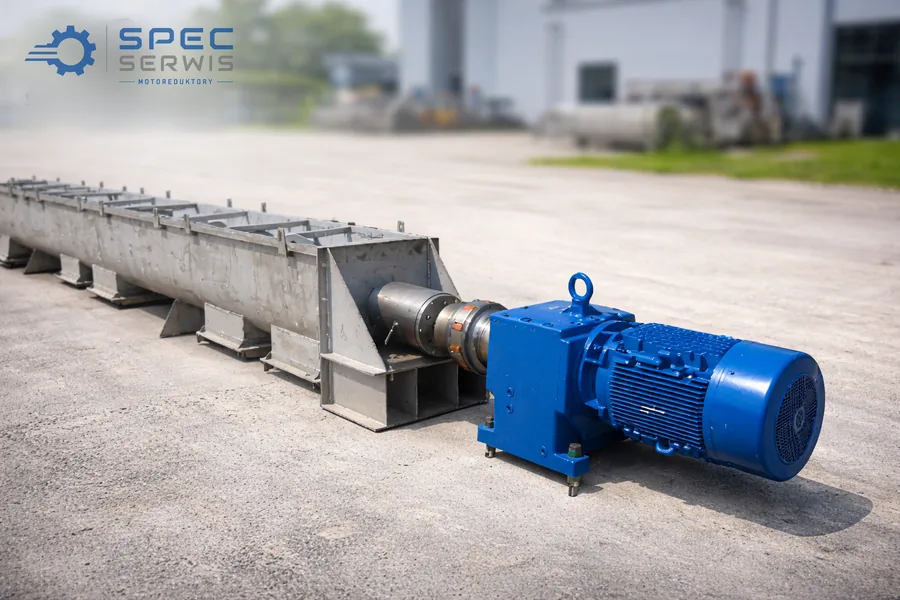
How to select drive power and torque
The starting point should not be the motor power alone, but the torque required at the output shaft. For a screw conveyor you need to determine at least the capacity, type of material, screw length, its diameter, installation position, starting frequency and expected temporary overloads. Only then are the screw speed and gear ratio selected.
In practice, the calculations are carried out so as to move from the required operating torque to the starting torque and select a safe reserve. This matters because a motor that is “sufficient” in a steady state may not cope when starting with a filled conveyor. CEMA states explicitly that selection for screw feeders should take into account considerably more difficult starting conditions than normal running alone.
With the motor itself, attention must be paid to its mechanical and electrical resistance. NORD states that its asynchronous motors are designed for high overload resistance, which matters precisely in conveying and material handling applications.
In many cases it is better to select a lower output speed and a higher torque, rather than “rescuing” the system with more power on too fast a shaft. A screw conveyor usually does not need aggressive dynamics. It needs a stable start, predictable operation and resistance to momentary load spikes.
For higher loads, it is worth considering NORD industrial solutions from the MAXXDRIVE XT family. The manufacturer recommends this series in particular for the bulk materials industry and for applications requiring low gear ratios with high thermal capacity and high torques. This is important wherever the drive operates for long periods under a high load and must not overheat.
Starting a screw conveyor – the most common problems
The most common mistake is the overly optimistic assumption that if a system operates correctly once up to speed, it will start just as easily. In reality, it is the starting torque that determines whether the drive will set off smoothly or will be overloaded, overheated or shut down by the protections.
A “direct” start with a full fill can also be a problem. In such a situation a very high torque peak occurs at start-up, and the motor current rises to a level that can cause alarms, voltage drops or a shortening of the entire system's service life. CEMA and the drive engineering literature emphasise that conveyors and feeders require an analysis not only of the operating power, but also of the acceleration characteristics and torque from zero speed.
The second common problem is an incorrectly configured frequency inverter. Too short a ramp, incorrect torque compensation, no overload control or wrongly selected motor parameters mean that a theoretically modern control system does not help – it makes starting worse. NORD indicates that its frequency inverters are intended for both synchronous and asynchronous motors, offering extensive safety functions and precise speed control, which is of direct importance in conveying applications.
In applications with a variable load, the overload capacity of the control system itself is also important. NORD cites application examples in which its drives achieve up to 400% starting torque, with a typical overload capacity of 200% for 5 seconds. Although the example concerns parcel handling, it shows how important dynamic reserve is in conveyor drives.
In practice, starting problems with a screw conveyor most often result from one of five causes:
- too small a torque reserve,
- an incorrectly selected gear ratio,
- starting with accumulated material,
- incorrect frequency inverter settings,
- no protection against screw blockage.
How to protect the drive against overload
The most important thing is to combine correct mechanical selection with electrical control. A larger gear unit alone will not solve everything if the system has no protection against the screw jamming or an incorrect start.
The basis is monitoring of current, temperature and starting time. If the drive starts drawing too high a current for too long, the system should limit the torque, stop the machine or signal an alarm. NORD frequency inverters offer safety functions such as STO and SS1, which support safe stopping and the protection of drive components.
In applications particularly exposed to blockage, it is worth providing additional mechanical protection measures. These may include overload couplings, shaft rotation sensors, loss-of-motion monitoring, bearing and gear unit temperature sensors or vibration monitoring. As a result, an overload does not immediately end in damage to the gear teeth or a twisted shaft.
Correct operation is also very important. Regular oil checks, verification of the installation position, assessment of the housing temperature and checking of the frequency inverter parameters reduce the risk of failure. SPEC SERWIS carries out, among other things, inspections, geared motor condition assessments, oil changes, reading of NORD frequency inverter parameters and thermal imaging checks. It is precisely such measures that help detect the signs of system overloading earlier.
The best NORD drive solutions
The selection of a specific solution depends on the scale of the application. For smaller and medium-sized systems, helical bevel geared motors or parallel shaft geared motors often work well, especially where high torque, a compact design and durability matter. NORD emphasises that its helical bevel geared motors achieve torques of up to 50,000 Nm, and their design is intended for demanding conveying applications.
For very heavy screw conveyors, especially in the bulk materials industry, MAXXDRIVE XT industrial gear units are a good direction. NORD describes them as a solution developed specifically for applications requiring low gear ratios, high load capacity and high thermal capacity. This is particularly important when the drive operates for long periods at high torque and has limited cooling conditions.
Where the priority is a controlled start and a better response to variable loads, it is worth combining the geared motor with a NORD frequency inverter. The manufacturer offers both control cabinet solutions and decentralised versions, with extensive control and safety functions. In applications with frequent load changes, NORD is also developing CFC control for synchronous motors, citing, among other things, 150% overload at start-up.
From the end user's point of view, however, the most important thing is not to choose the “most powerful” drive, but to match the system to the real conditions of the process. SPEC SERWIS supports customers with advice on the selection of NORD solutions, helps translate application parameters into the right drive selection and provides support in technical contact with the manufacturer. This way of working follows directly from the design brief and the company's offering materials.
Summary
A geared motor for a screw conveyor must be resistant not only to normal operation, but above all to a heavy start, momentary increases in resistance and the risk of material blockage. That is why the key factors in this application are: a correctly calculated torque, the right gear ratio, a starting reserve, a properly configured frequency inverter and effective overload protection. A poorly selected system may work for a while, but it will wear out faster and cause downtime more often.
A well-selected NORD drive makes it possible to reduce the risk of failure, improve starting stability and achieve greater predictability of the entire conveyor's operation. In practice, it is this that determines the durability of the system, not the power value on paper alone.
FAQs
Below you will find short answers to the most common questions related to selecting a drive for a screw conveyor.
Does a screw conveyor always require a higher torque than steady-state operation suggests?
Yes, very often this is necessary. Starting a screw conveyor can be significantly harder than running it once up to speed, especially when material is sitting in the trough or the system works as a screw feeder. CEMA explicitly points to the need to take difficult starting conditions into account when selecting power and torque.
What most often causes gear unit overload in such a system?
Most often these are: starting under a full fill, caked material, an incorrectly selected gear ratio, too small a torque reserve and incorrect frequency inverter settings. The problems are also aggravated by poor operation, e.g. the wrong oil or an incorrect installation position of the geared motor.
Does a frequency inverter help when starting a screw conveyor?
Yes, provided it is correctly selected and configured. A frequency inverter enables a softer start, ramp control, overload limitation and better matching of speed to the process. NORD offers frequency inverters with precise control and safety functions for such applications.
When is it worth considering an industrial gear unit instead of a classic geared motor?
When the screw conveyor operates with a very high torque, high inertia, long cycles under load or in the demanding bulk materials industry. In such conditions the MAXXDRIVE XT series is a logical direction, as it was developed precisely for bulk material handling applications.
What data do you need to prepare for drive selection?
The minimum is: type of material, capacity, screw length and diameter, installation position, expected speed, starting frequency, ambient conditions and information on whether starting takes place with a full fill. Without this data it is difficult to reliably select the starting torque and protect the system against overload.
How can SPEC SERWIS help with such an application?
SPEC SERWIS provides advisory support in drive selection, assists with the analysis of application parameters and helps with technical contact with NORD, as well as supporting the assessment of the condition of the existing geared motor and frequency inverter. This approach is in line with the company's design and offer materials.